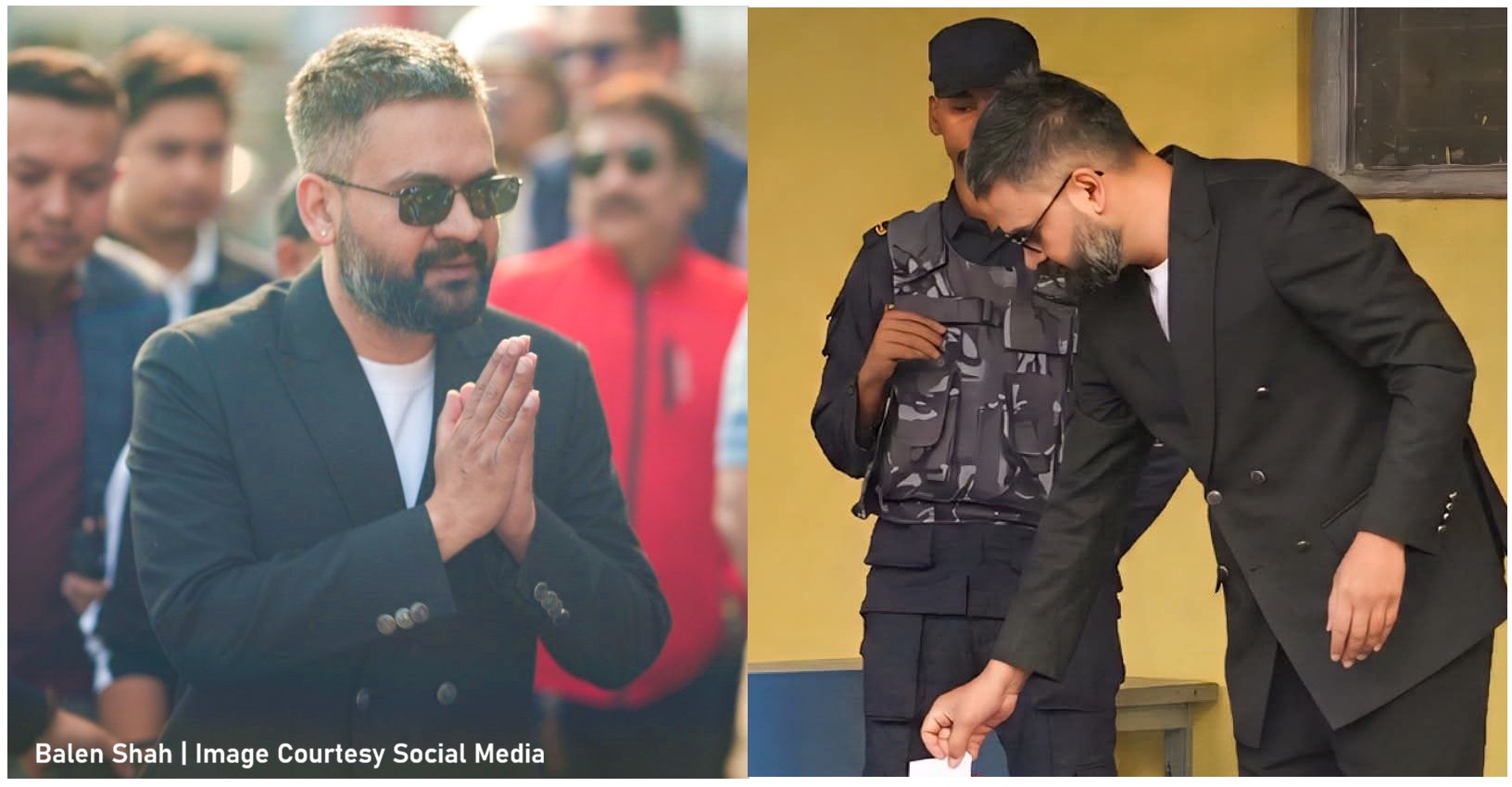

Kathmandu, 5 March : Nepal went to the polls on March 5, 2026, in what many are calling the most consequential election in the Himalayan nation’s recent history. At the center of this political earthquake stands Balendra Shah, a 35-year-old former rapper and ex-mayor of Kathmandu, who has emerged as the most talked-about challenger to former Prime Minister KP Sharma Oli. The election is not just about choosing a government. It is a referendum on whether Nepal’s youth can finally displace the entrenched political class that has governed, and in many eyes misgoverned, the country for over two decades.
This is the first national election since the deadly Gen Z uprising of September 2025, when thousands of young Nepalis stormed the streets to demand accountability, jobs, and an end to systemic corruption. The protests, which left at least 77 people dead and caused massive destruction, including the burning of parliament and government offices, forced Prime Minister Oli to resign. An interim government led by former Supreme Court Chief Justice Sushila Karki, the first woman to ever lead Nepal, was installed with the sole mandate of stabilizing the country and holding free elections within six months.
Nearly 19 million citizens are registered to vote in this election, including over 800,000 first-time voters, many of whom belong to the very generation that led the September uprising. Voters are casting two ballots: one to elect 165 members from single-member constituencies through a first-past-the-post system, and another to choose 110 members through proportional representation. Over 3,400 candidates from 68 political parties are competing, and a combined security force of 320,000 personnel has been deployed to ensure peaceful polling.
WHO IS BALEN SHAH?
Balendra Shah was a nobody in public life until 2013, when he burst onto Nepal’s hip-hop scene with politically charged rap songs that criticized government failures and corruption. Born in April 1990 in Kathmandu to a family originally from the Madhesh region, Balen is a civil engineering graduate who completed his postgraduate studies in structural engineering at Visvesvaraya Technological University in Karnataka, India. He is currently pursuing a PhD in traditional infrastructure conservation at Kathmandu University.
In May 2022, Balen pulled off one of the biggest political upsets in Nepal’s history by winning the Kathmandu mayoral race as an independent candidate, defeating established nominees from the Nepali Congress and the CPN-UML. As mayor, he tackled the city’s chronic garbage crisis, cracked down on illegal construction, and improved traffic management. However, his tenure was also marked by controversy over aggressive demolition drives, the displacement of squatters, and a heavy-handed approach toward street vendors.
When the Gen Z protests erupted in September 2025, Balen became the protesters’ first choice for interim prime minister, but he turned down the role and instead supported Sushila Karki for the position. In January 2026, he resigned as Kathmandu mayor and formally joined the Rastriya Swatantra Party (RSP), which declared him its prime ministerial candidate. Under a seven-point agreement, RSP president Ravi Lamichhane retained party leadership while Shah became the alliance’s face for the top executive post.
THE BATTLE OF GENERATIONS: BALEN VS OLI
The most symbolic contest of this election is unfolding in Jhapa-5, where Balen has chosen to go head-to-head against Oli himself, the 74-year-old CPN-UML chairman and the man whose government was toppled by the youth uprising. Analysts view this as a deliberate move to frame the election as a battle between Nepal’s past and its future.
Nepal’s demographics strongly favor change. Over 40 percent of the population is under 35, and the country’s median age is just 26. Among registered voters, 52 percent are aged 18 to 40, making young people the single most powerful voting bloc. The RSP has embraced this reality by fielding nine Gen Z candidates, many of whom are close associates of Shah. Across all parties, a total of 160 Gen Z candidates are contesting these elections. Two-thirds of lawmakers from the previous parliament are not running this time, further underscoring the generational shift underway.
The established parties, meanwhile, face a deep crisis of legitimacy. The CPN-UML, the Nepali Congress, and the former Maoist forces have dominated Nepali politics for two decades, yet the country has seen 14 governments and nine prime ministers since becoming a republic in 2008. This revolving door of leadership, combined with rampant corruption and economic stagnation, is precisely what fueled the September revolt.
CONTROVERSY OVER INDIA AND CHINA REMARKS
One of the most closely watched dimensions of this election is its foreign policy implications. Nepal sits between two giants, India and China, and its political leaders have traditionally navigated this delicate geopolitical position through careful diplomatic balancing.
Balen Shah has upended this tradition with his fiery and often undiplomatic rhetoric. In November 2025, while still serving as Kathmandu mayor, he posted a profanity-laden message on Facebook targeting India, China, the United States, and nearly every major Nepali political party. The post was deleted within 30 minutes, but not before thousands had taken screenshots. It drew 34,000 reactions and 12,000 comments in just 22 minutes.
In 2023, Shah provoked India by displaying a Greater Nepal map in his mayoral office, referencing an irredentist claim to territories lost under the 1816 Treaty of Sugauli. He has repeatedly raised the Kalapani-Lipulekh border dispute and accused India of interfering in Nepali politics. As mayor, he also briefly banned Indian films in Kathmandu cinemas before the Supreme Court reversed the order.
However, Shah has been notably cautious on China as well. He recently dropped the China-backed Damak Industrial Park, a Belt and Road Initiative project, from his election manifesto. The multi-billion-rupee project, located near the sensitive Siliguri Corridor that connects mainland India with its northeastern states, had been flagged by New Delhi as a strategic red line. By excluding it, Shah appeared to signal an awareness of India’s security concerns, even as he publicly maintains a “Nepal first” stance. His party’s manifesto envisions transforming Nepal from a “buffer state” into a “vibrant bridge” through trilateral economic engagement with both neighbors.
Diplomatic observers note that Shah’s approach reflects more impulse than strategy. A former Nepali ambassador cautioned that national governance demands careful management of relationships with India and China, and that Shah’s mayoral style of operating through social media outbursts would not translate well to the prime minister’s office. RSP leaders have reportedly adopted a more restrained tone on foreign policy matters as the election approached.
WHAT IS AT STAKE FOR NEPAL’S FUTURE?
The outcome of this election carries enormous implications. Nepal’s mixed electoral system historically prevents single-party majorities, making coalition governments almost inevitable. The key question is whether the RSP, even if it performs strongly, can secure enough seats to lead a government, or whether the old parties will regroup to keep Balen Shah and the reform movement out of power.
Pre-election analysis suggests that the RSP is expected to significantly increase its seat tally from the 21 seats it won in 2022. The Nepali Congress, which has undergone its own generational shift under younger leaders like Gagan Thapa, could emerge as another major force. The CPN-UML, widely seen as the biggest loser of the September uprising, may see a sharp decline.
For the international community, the election is being watched as a test of whether democratic protest movements can successfully translate street energy into electoral outcomes and institutional reform. The UNDP, along with UN Women, has been supporting voter participation and digital literacy ahead of the polls. Nearly 4,500 domestic and international observers from 40 organizations are monitoring the process.
Results for the directly elected seats are expected within two days, while the proportional representation tallies could take an additional two to three days. Nepal could know its next government by late on March 7 or early March 8.
Regardless of who wins, the next prime minister faces a daunting set of challenges: rebuilding public institutions damaged during the uprising, reviving an economy battered by years of instability, managing the delicate India-China balancing act, and meeting the expectations of a young population that has shown it will not tolerate business as usual.