
Pakyong, March 3 : As tensions rise between Israel, the United States, and Iran, global focus has sharply shifted to one of the world’s most critical energy chokepoints, the Strait of Hormuz. This narrow maritime corridor has once again become the center of geopolitical anxiety, raising concerns about global oil markets and energy security.
India gets nearly 50% of its crude oil imports through the Strait of Hormuz, situated along Iran’s southern coastline. However, due to the ongoing conflict and reported blockades in the region, shipping movements through this key route have slowed significantly. Currently, reportedly India is estimated to have a Strategic Petroleum Reserve enough for about 25 days, which raises concerns about supply stability if disruptions continue.
Why the Strait of Hormuz Matters
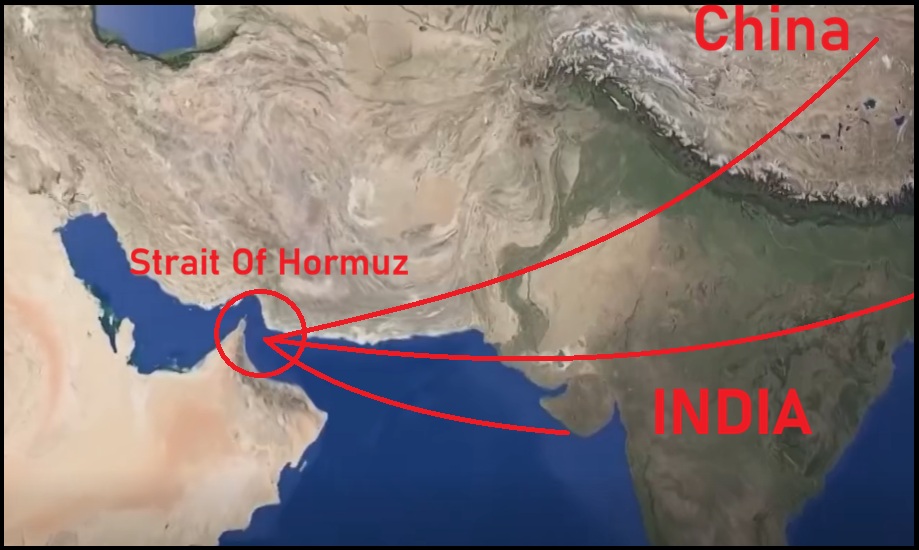
The Strait of Hormuz connects the Gulf of Oman to the Persian Gulf. It is a vital energy artery for the global economy. Nearly 25% of the world’s crude oil consumption passes through this narrow passage. Major Asian economies including India, China, and Japan heavily rely on oil shipments that transit this route.
Geographically, Iran controls the northern side of the strait, while Oman and the United Arab Emirates, including Dubai, lie along the southern flank. This closeness has made the region one of the most geopolitically sensitive maritime areas in the world.
Iran’s Strategic Leverage
Over the years, Iran has consistently threatened to close the Strait of Hormuz to exert pressure on Western powers. While these threats have often been seen as strategic warnings rather than immediate actions, the current Iran, Israel, and US conflict has heightened tensions to a new level.
Reports indicate that Iranian forces have effectively limited movement through the strait, increasing fears of extended disruptions. However, analysts note that Iran’s own oil exports also rely on this route, meaning a complete and permanent closure would hurt Tehran economically.
Global Power Dynamics at Play
For the United States, a prolonged shutdown of the Strait of Hormuz presents wider geopolitical risks. If oil shipments remain blocked, major importers like India and China may increasingly turn to Russia for energy supplies. Such a shift could significantly enhance Moscow’s position in global energy markets.
In that scenario, Russian President Vladimir Putin could become one of the world’s most powerful oil suppliers without having to increase production—simply due to changing trade flows driven by conflict.
A Dangerous Turning Point
Adding to the uncertainty are reports that Iran’s Supreme Leader Ayatollah Ali Khamenei was killed in US action. If this is true, it could lead Tehran to respond more aggressively. Observers warn that if Iran feels it has little left to lose, the risk of further escalation in the Strait of Hormuz and beyond increases dramatically.
With nearly a quarter of the world’s oil supply passing through this narrow waterway, the growing crisis is no longer just a regional conflict—it is a global economic concern.