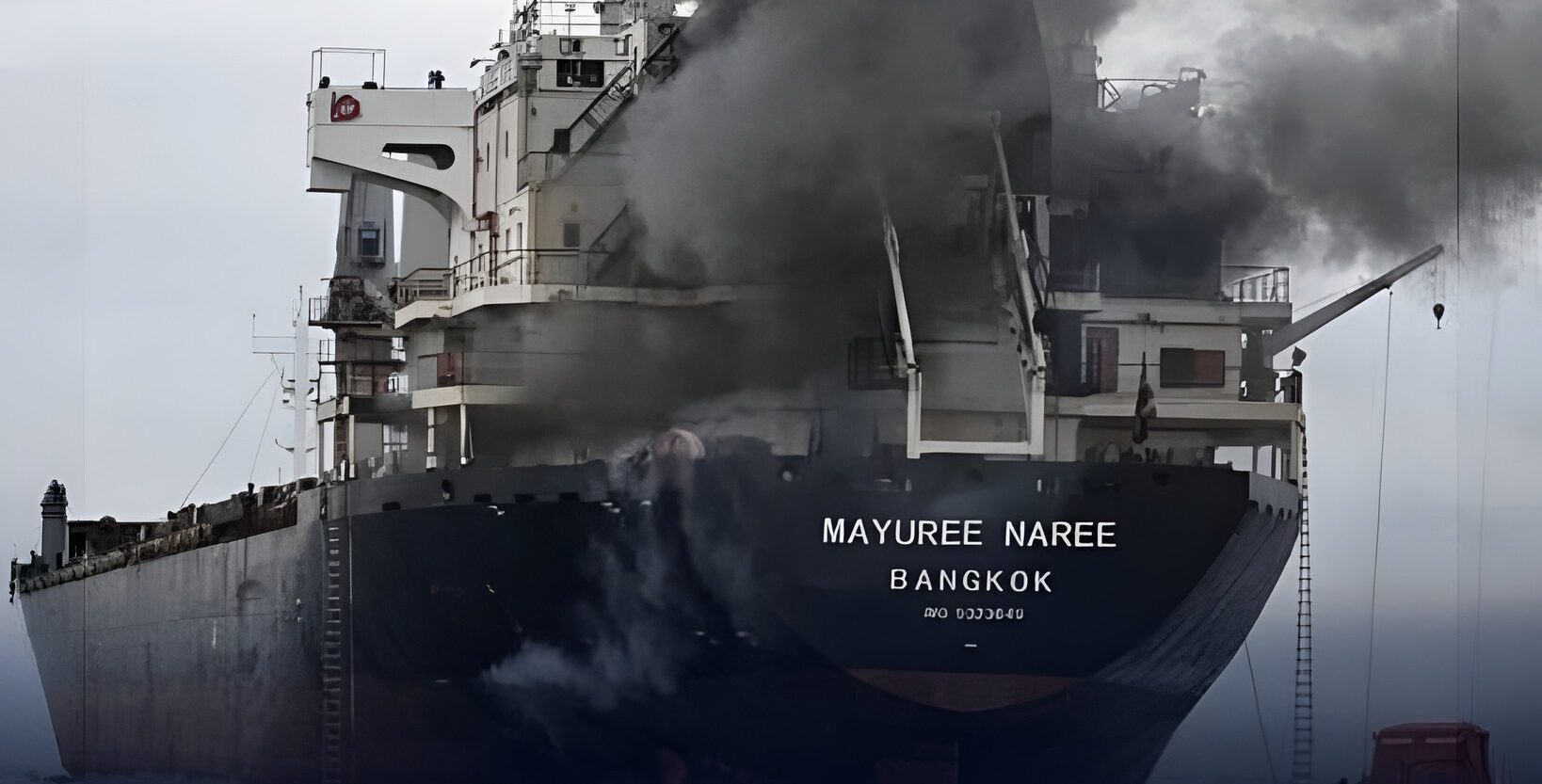

New Delhi, March 12 : A ship heading toward India’s Gujarat coast was reportedly targeted in an attack on Wednesday near the strategically vital Strait of Hormuz, one of the world’s most crucial sea routes. The incident has raised fresh concerns over India’s energy supply chain and maritime trade security.
The vessel, identified as Mayuree Naree , owned by a Thailand-based company, came under attack about 11 nautical miles north of the Omani coastline. According to reports, the ship had departed from Khalifa Port and was carrying fuel cargo destined for the Indian state of Gujarat.
International media reports stated that an unidentified projectile struck the vessel, triggering a major fire onboard. The blaze temporarily disrupted operations on the ship, forcing the crew to initiate emergency safety procedures and move to secure locations until the situation was brought under control.
The Strait of Hormuz remains one of the most sensitive and heavily monitored maritime corridors in the world. A substantial portion of crude oil and natural gas exported from Gulf nations passes through this narrow channel to reach global markets. Although the strait is about 33 kilometers wide, the designated shipping lanes used by tankers are only around 11 kilometers wide, making it a highly strategic yet vulnerable zone.
India relies heavily on energy imports from Gulf countries such as Saudi Arabia, Iraq, Kuwait, and the United Arab Emirates. Most of these supplies pass through this narrow waterway, meaning any disruption in the area could have direct consequences for India’s energy security.
Tensions in the Middle East have been escalating following recent airstrikes by the United States and Israel targeting positions inside Iran. In response, Iran is believed to have intensified attacks aimed at US military installations and energy transport routes across the Gulf region.
Due to rising security risks, several major global shipping companies have reportedly reduced their use of the Hormuz route. In the past 72 hours, only two international oil tankers have managed to cross the passage, highlighting the growing uncertainty in the region.
If the situation continues to deteriorate, vessels bound for India may be forced to take the much longer route around Africa. Such a diversion could add nearly two weeks to shipping time and significantly increase transportation costs.
The escalating tensions have also pushed global crude oil prices upward. International benchmark prices have already crossed $100 per barrel, raising the possibility of higher fuel prices for petrol, diesel, and cooking gas in India.
Meanwhile, the International Energy Agency has announced plans to release around 400 million barrels of oil from emergency reserves to stabilize global supply. Of this amount, the United States alone has pledged to contribute approximately 172 million barrels.