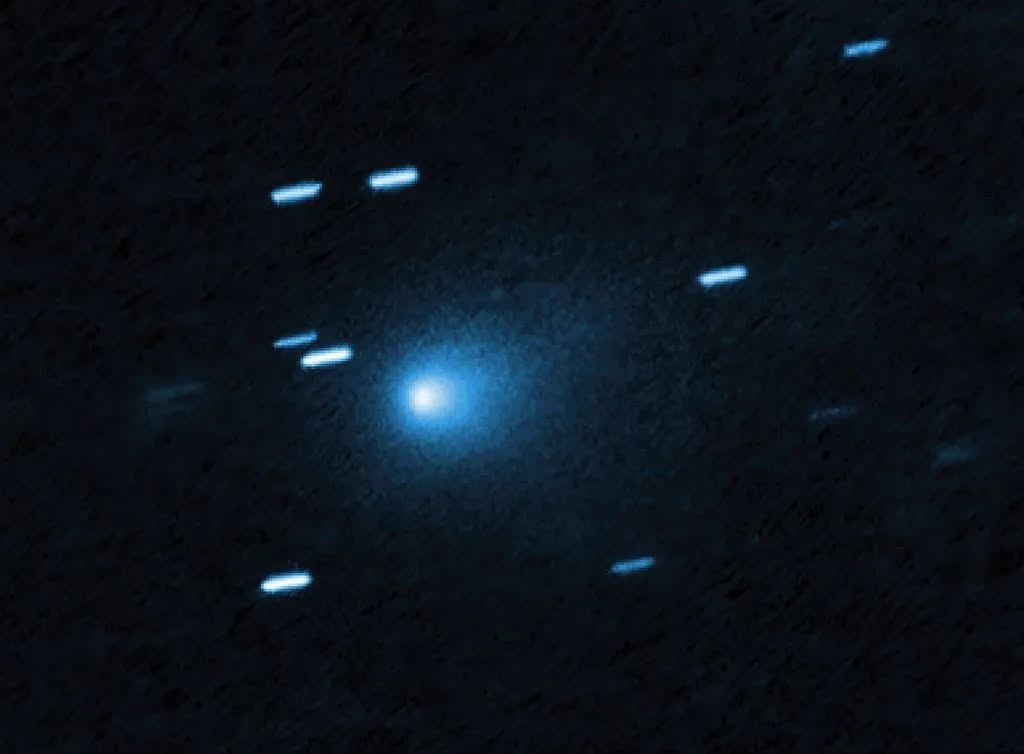

3i/ATLAS (NASA), Dec 9 : The scientific community has been buzzing since the discovery of the third-known interstellar object, designated 3I/ATLAS, on July 1, 2025. Spotted by the ATLAS telescope in Chile, this celestial wanderer follows the path of its predecessors, 1I/ʻOumuamua and 2I/Borisov, proving it originated from deep space far beyond our solar system. However, recent data has sparked sensational questions: Could this object be carrying dangerous materials?
New observations utilizing the powerful Atacama Large Millimeter/Submillimeter Array (ALMA) have detected significant quantities of hydrogen cyanide (HCN) and methanol (CH3OH) emanating from the comet. While the presence of such toxic compounds might sound alarming to the layperson—evoking fears of “weapons of mass destruction”—astronomers offer a fascinating, life-affirming explanation that contradicts the fear-mongering.
Decoding the Signals: Poison or Precursor?
Between August and October 2025, as 3I/ATLAS raced between 2.6 and 1.7 astronomical units from the Sun, ALMA captured distinct chemical signatures. The findings revealed a complex interplay of gases:
Hydrogen Cyanide (HCN): Detected emerging directly from the comet’s nucleus.
Methanol (CH3OH): Found in higher concentrations on the sunward side and extending into the gas plume over 258 kilometers away.
What makes 3I/ATLAS unique is its chemical balance. The ratio of methanol to hydrogen cyanide is exceptionally high, a trait rarely seen in our local comets (with the exception of comet C/2016 R2). Rather than a threat, these chemicals are standard components of the “cosmic ice” found in star-forming regions. They are the chemical precursors—the building blocks—required for organic chemistry.
The Building Blocks of Life
To understand why NASA has deemed 3I/ATLAS harmless, one must look at biochemistry rather than warfare. While hydrogen cyanide was indeed used as a weapon in WWI, in an astronomical context, it is a vital ingredient for life.
Methanol: A fundamental structure for creating amino acids and sugars. It has been observed in planet-forming discs and is used by microorganisms on Earth as an energy source.
Hydrogen Cyanide: A key player in the formation of nucleic acid bases like adenine (essential for DNA). In nature, it aids in plant defense and seed germination.
Essentially, 3I/ATLAS is not a weapon; it is likely a capsule of prebiotic material, supporting the theory of panspermia—the idea that comets may ferry the ingredients for life across the universe.
A Fleeting Visit
NASA’s Center for Near Earth Object Studies (CNEOS) has confirmed that 3I/ATLAS poses no impact threat to Earth. Traveling at blistering speeds exceeding 210,000 kilometers per hour, the comet is on a hyperbolic trajectory.
This means it is moving too fast to be captured by the Sun’s gravity. It will sweep through our neighborhood, offering a brief glimpse into the chemistry of a distant solar system, before exiting into the void forever.
Rather than a harbinger of doom, 3I/ATLAS is a messenger, carrying the frozen, organic history of the stars.