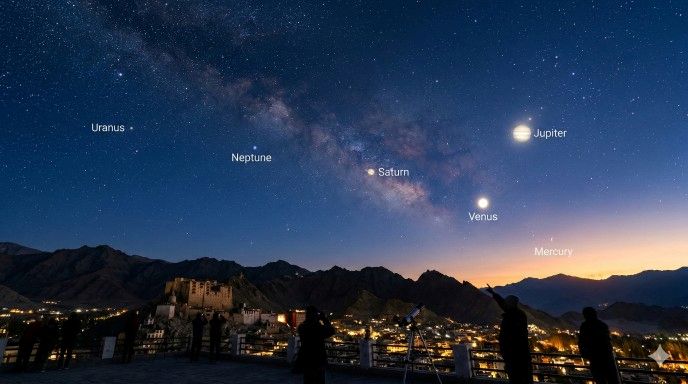
Mercury, Venus, Saturn, Jupiter, Uranus and Neptune Align in a Rare Cosmic Spectacle Visible Across India Shortly After Sunset — Next Similar Event Not Expected Until 2034
Published: February 27, 2026 | New Delhi, India

India is about to witness one of the most spectacular celestial shows of the decade. On Saturday, February 28, 2026, six planets of our solar system will align along the evening sky in a breathtaking phenomenon known as a “planetary parade.” Mercury, Venus, Saturn, Jupiter, Uranus and Neptune will appear to stretch across the horizon in a sweeping arc shortly after sunset, offering millions of Indians a rare front-row seat to the grandeur of our cosmic neighbourhood.
According to NASA and leading astronomical bodies, February 28 marks the peak of this alignment, when the six planets will be grouped most tightly above the horizon during the evening twilight window. While planetary alignments involving two or three bodies are relatively common, the simultaneous visibility of six planets in a single evening sky is a genuinely uncommon event — one that skywatchers, amateur astronomers and science enthusiasts across the country are preparing to observe with great anticipation.
What Exactly Is a Planetary Parade?
A planetary parade, also referred to as a planetary alignment, occurs when multiple planets appear to line up along the ecliptic — the imaginary path that the Sun, Moon and planets trace across the sky as viewed from Earth. It is important to note that these planets are not physically close to each other in space; they are separated by hundreds of millions of kilometres. However, from Earth’s vantage point, their orbital positions create the stunning visual illusion of a coordinated cosmic procession stretching across the heavens.
The February 2026 planetary parade is particularly noteworthy because it features six planets appearing simultaneously in the post-sunset sky. The lineup includes the inner planets Mercury and Venus near the western horizon, the gas giant Jupiter higher in the sky, the ringed planet Saturn, and the distant ice giants Uranus and Neptune. This combination of both naked-eye and telescope-only targets makes the event especially engaging for observers with varying levels of equipment and experience.
When and How to Watch from India
The best viewing window for observers in India is between approximately 6:15 PM and 8:00 PM IST on the evening of February 28, 2026. The ideal time to begin scanning the sky is about 30 to 60 minutes after local sunset, when the sky has darkened enough for fainter objects to become visible but before the lower planets dip below the western horizon.
Observers should look towards the western and south-western horizon, where the planets will be arranged along the ecliptic in a gentle arc. Venus will be the most brilliant object in the lineup, unmistakable even in twilight. Jupiter, positioned higher in the sky towards the east, will also be easily visible as a bright, steady point of light. Saturn and Mercury should be identifiable with the naked eye under clear conditions, although Mercury’s low position near the horizon may pose a challenge in areas with haze or light pollution. Uranus and Neptune, being substantially dimmer, will require binoculars or a small telescope to detect.
Planet-by-Planet Visibility Guide for Indian Observers
| Planet | Brightness | Visibility | Viewing Tips for India |
|---|---|---|---|
| Mercury | Faint, near horizon | Naked eye (difficult) | Low western horizon; look immediately after sunset |
| Venus | Very bright | Naked eye (easy) | Brightest object in lineup; unmistakable in western sky |
| Saturn | Moderate brightness | Naked eye | Low in western sky near Mercury; steady golden light |
| Neptune | Very faint | Telescope required | Near Saturn; virtually invisible without optics |
| Uranus | Faint | Binoculars recommended | Higher in sky, in constellation Taurus |
| Jupiter | Very bright | Naked eye (easy) | Highest and brightest; look south-east to east |
Best Viewing Locations Across India
While the planetary parade will be visible across the entire country, certain regions offer significantly better conditions for sky observation. Areas with minimal light pollution and clear atmospheric conditions will provide the most rewarding experience. Ladakh, with its high altitude and exceptionally dark skies, is considered one of the finest stargazing destinations in the country. Parts of Rajasthan, particularly the desert regions around Jaisalmer and Barmer, also offer superb sky clarity. The rural stretches of Madhya Pradesh and coastal Tamil Nadu are similarly well-suited for this event.
Urban residents in metro cities such as Delhi, Mumbai, Kolkata, Bengaluru, Hyderabad and Chennai need not despair. The brightest planets in the alignment — Venus, Jupiter and Saturn — should still be clearly visible from city rooftops or open parks with an unobstructed view towards the western horizon. The key is to find a location away from tall buildings and bright streetlights that could wash out the fainter objects.
Practical Tips for the Best Experience
To make the most of this celestial event, observers should begin preparing their viewing spot before sunset to allow their eyes to adjust to diminishing light. A clear and unobstructed western horizon is absolutely essential. Bringing a pair of binoculars will dramatically improve the chances of spotting Uranus and Saturn’s rings. For those who want to identify each planet with precision, smartphone stargazing applications such as Star Walk 2, Stellarium or Sky Tonight can overlay planet positions on the live sky in real time.
Weather will play a crucial role in visibility. Observers should check local forecasts in advance and be prepared for the possibility that cloud cover may obscure parts of the sky. If conditions on February 28 are unfavourable, the days immediately before and after the peak date will still offer a worthwhile, though slightly less tightly grouped, view of the alignment.
Scientific Context and Significance
Astronomers emphasise that planetary parades are purely visual phenomena resulting from the geometry of planetary orbits. The alignment has no measurable gravitational effect on Earth and carries no scientific implications beyond the opportunity for public engagement and education. However, such events serve as powerful catalysts for inspiring interest in astronomy, particularly among young students and first-time stargazers who may be seeing planets as distinct points of light for the very first time.
The rarity of this specific configuration adds to its appeal. Experts have noted that a comparable five-planet alignment is expected to be visible before sunrise in late October 2028, while the next similar evening alignment of this many planets is not anticipated until February 2034. This makes the February 28 event a genuinely special window for Indian observers who may not get another convenient evening opportunity for nearly a decade.
India’s Growing Astronomy Culture
Events like the planetary parade have taken on renewed significance against the backdrop of India’s expanding space ambitions and growing public interest in astronomy. With ISRO’s continuing missions and the proliferation of citizen science communities, amateur astronomy clubs and educational outreach programmes across Indian cities and towns, celestial events are no longer the exclusive domain of professional scientists. Observatories, planetariums and science centres in cities such as Pune, Bengaluru, Kolkata, Hyderabad and Thiruvananthapuram are expected to host special viewing sessions and public programmes around the event.
Whether you are an experienced astronomer with a telescope or a curious first-time observer with nothing but your eyes and an open sky, the evening of February 28, 2026 promises a cosmic spectacle worth stepping outside for. Clear your evening schedule, find a spot with a view to the west, and look up — the universe is putting on a show.
Disclaimer: Visibility is subject to local weather conditions, atmospheric clarity and light pollution levels. The times mentioned are approximate and may vary slightly by city. Consult a stargazing app for precise positions based on your location.