
Gangtok, April 8 : Chief Minister Prem Singh Tamang (Golay) returned from New Delhi with a clutch of significant wins for Sikkim — a Prime Ministerial confirmation for the state’s landmark Golden Jubilee celebrations, a fresh infusion of Rs 820 crore under the Union Budget, and renewed federal attention on the state’s prized cardamom economy.
In a packed round of high-level meetings in the capital, CM Golay called on Prime Minister Narendra Modi, Union Finance Minister Nirmala Sitharaman, and Union Agriculture Minister Shivraj Singh Chouhan — covering ground from border trade revival to organic farming futures.
MODI MEETING: SILK ROUTE REVIVAL AND A GOLDEN INVITATION
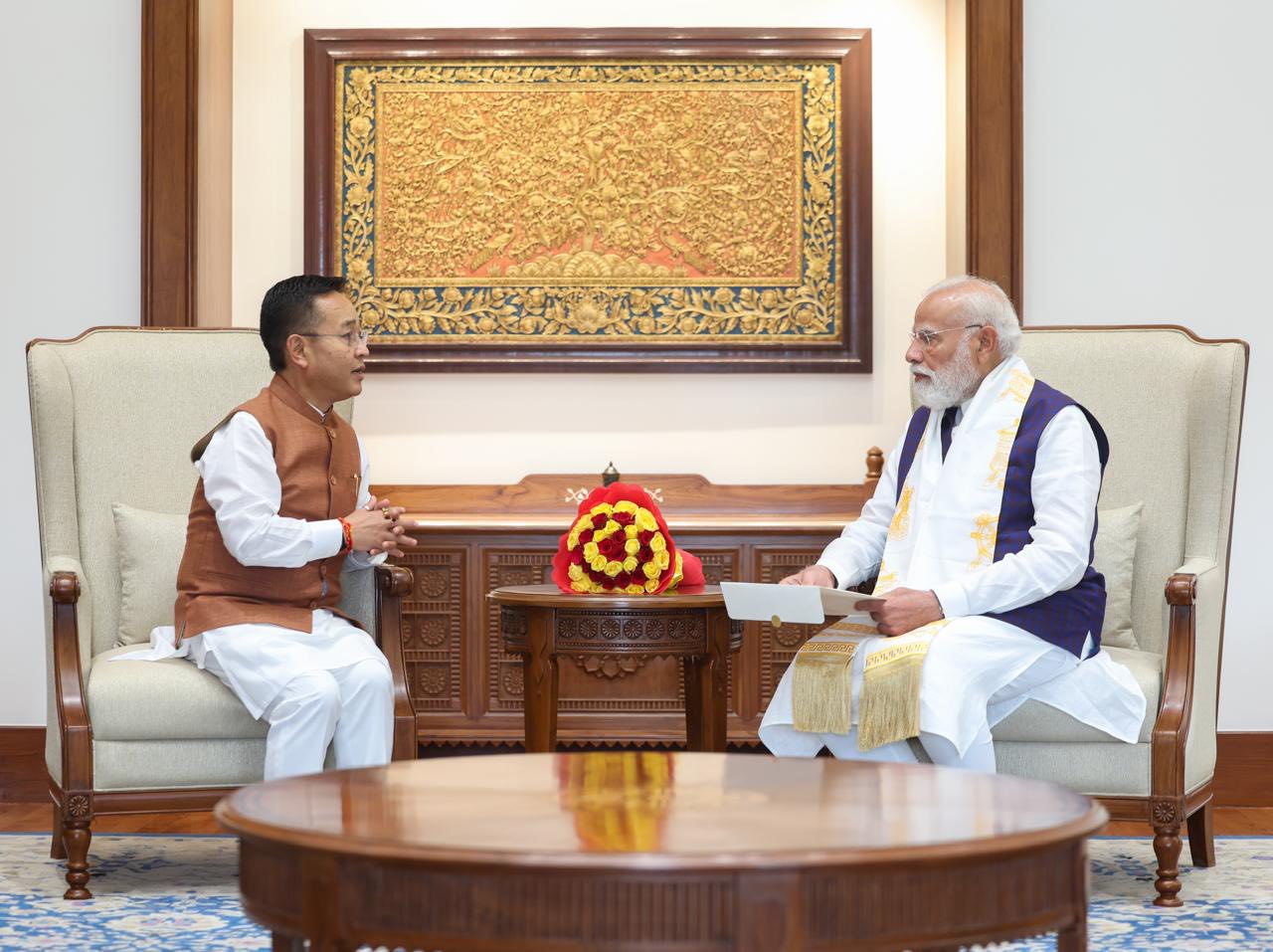
The Delhi visit opened on a historic note. CM Golay met Prime Minister Modi and began by congratulating him on becoming India’s longest-serving head of government — a milestone that has drawn wide acknowledgment across political circles.
But the meeting was far from ceremonial. Golay laid out Sikkim’s developmental priorities with clarity — infrastructure gaps, sustainable growth needs, and welfare demands of a small but strategically vital Himalayan state.
The headline outcome was the reaffirmation of the Nathu La Pass trade route reopening, slated for June 2026. The ancient Silk Route corridor, linking Sikkim to Tibet, has long been considered a lifeline for border communities and traders alike. Its revival after a prolonged suspension is expected to inject fresh economic momentum into the region.
The Chief Minister also extended a formal invitation to the Prime Minister for the closing ceremony of Sikkim’s Golden Jubilee of Statehood — marking 50 years since Sikkim’s merger with India in 1975. Modi accepted the invitation, a development that will lend considerable national weight to what promises to be a defining moment in the state’s history.
SITHARAMAN MEETING: Rs 820 CRORE HILL STATE BOOST

In his meeting with Finance Minister Nirmala Sitharaman, CM Golay expressed the state’s gratitude for what could be one of the more consequential budget provisions for Sikkim in recent memory.
Under the Union Budget 2026-27, Part-X of the SASCI framework — titled Pride of Hills: Special Development Assistance for the Hill States — has earmarked a dedicated allocation for states like Sikkim that contend with the unique fiscal and geographic challenges of mountainous terrain. Sikkim stands to receive an additional Rs 820 crore under this provision.
Golay described the allocation as a recognition by the Centre of the structural disadvantages that hill economies navigate — from high infrastructure costs to limited revenue-generating capacity. Discussions during the meeting also touched on accelerating financial flows to the state and building out infrastructure to support long-term sustainable growth.
The Finance Minister’s upcoming visit to the Vibrant Villages programme — PM Modi’s flagship initiative aimed at energising border-area communities — also came up, with Golay extending a warm welcome for the visit and underlining the programme’s transformative impact on Sikkim’s frontier villages.
CHOUHAN MEETING: CARDAMOM, COOPERATIVES AND A FARM-TO-FUTURE PUSH

The third and perhaps most substantive policy meeting came with Agriculture Minister Shivraj Singh Chouhan, where the agenda ranged from crop productivity to rural infrastructure.
Large cardamom — Sikkim’s dominant cash crop and one it has long sought to position as a global specialty product — took centre stage. Golay and Chouhan discussed strategies to boost cultivation, improve yields, and create value-addition opportunities that could help farmers earn better returns beyond the raw commodity stage.
A recurring theme in the conversation was the need to close the persistent gap between agricultural research and on-ground farming practice. The lab-to-land approach — translating scientific advances into actionable guidance for farmers — was identified as a priority area requiring stronger institutional backing.
The two leaders also deliberated on the Viksit Krishi Sankalp Abhiyan, a programme aimed at widening agricultural outreach, as well as the role of IFFCO (Indian Farmers Fertiliser Cooperative Limited) in improving input access for Sikkim’s farming communities.
Chouhan, too, accepted CM Golay’s invitation to attend the Golden Jubilee closing ceremony — adding another senior Central figure to what is shaping up as a nationally attended milestone event for the state.
Rural development and broader infrastructure priorities also featured in the discussion, rounding out what was by all accounts a comprehensive bilateral exchange.
A STATE PUNCHING ABOVE ITS WEIGHT
Small in geography but increasingly assertive in its federal engagement, Sikkim under Golay’s leadership has consistently sought to leverage its strategic location and ecological distinctiveness to draw Central attention and resources.
This round of Delhi meetings underscores that approach. From border trade to budget allocations, from organic agriculture to a jubilee celebration with Prime Ministerial presence — the state appears to be entering its 51st year with both ambition and federal goodwill firmly in its corner.
The Golden Jubilee closing ceremony, now confirmed to host the Prime Minister, is likely to serve as a moment not just of historical reflection but of projecting Sikkim’s developmental trajectory to a national audience.