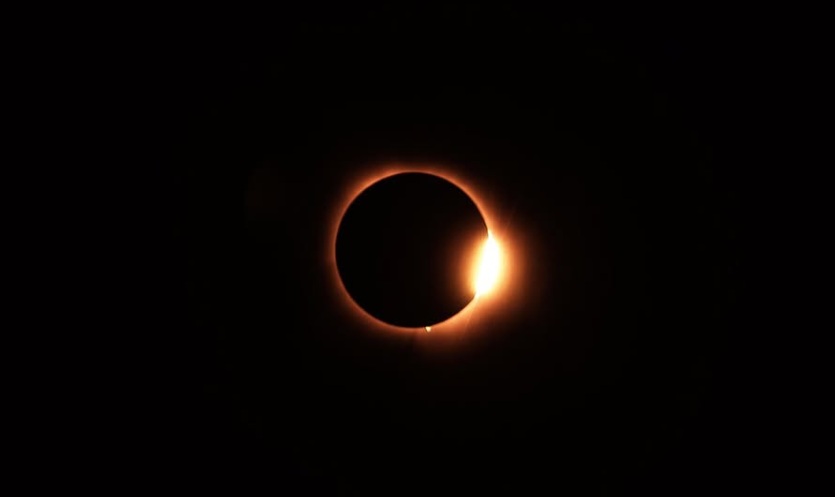

Gangtok, 16 Feb : The first major celestial event of 2026, Surya Grahan (solar eclipse), will occur on Tuesday, February 17, 2026. This event will create a remarkable annular eclipse, also referred to as a “Ring of Fire” effect, where the Moon covers most of the Sun’s disk while leaving a glowing ring around it.
According to astronomical calculations, the eclipse will start at 3:26 PM IST and last until 7:57 PM IST. It will last about 4 hours and 31 minutes, with its peak phase occurring between 5:13 PM and 6:11 PM.
Although this event is significant, it will not be visible in India. The eclipse path will cover parts of southern Africa, South America, and Antarctica due to Earth’s rotation and the position of the shadow.
In Hindu tradition, a period known as Sutak Kaal usually begins 12 hours before a solar eclipse. This timeframe is considered temporarily inauspicious and is often marked by certain religious restrictions. However, since this eclipse will not be visible from India, many believe that Sutak Kaal won’t apply in India, allowing normal activities to continue on that day.
Astronomically, an annular solar eclipse occurs when the Moon is at a point in its orbit where it appears slightly smaller than the Sun. This means it doesn’t completely cover the solar disk. As a result, it creates a thin, bright ring, the “Ring of Fire,” which characterizes the phenomenon and attracts the attention of sky watchers and scientists around the world.
Though Indians won’t see the eclipse directly, many still engage in traditional practices like chanting mantras and performing rituals during this time. They consider the spiritual energy linked to Surya Grahan, especially since the overlapping Phalguna Amavasya (new moon day) falls on the same date.