
New Delhi, March 5 : If you have ever felt overwhelmed trying to find the perfect restaurant, missed a tricky highway exit, or spent ten frustrating minutes scanning reviews just to find a café open past 9 PM, your daily commute and travel life are about to change forever.
On March 12, 2026, Google officially unveiled what industry experts and its own leadership are calling the biggest update to Google Maps in over a decade. This is not a minor feature drop. This is Google transforming Maps from a passive navigation tool into an active, intelligent travel partner — and the implications for how 2 billion+ people move through the world every day are staggering.
Powered by Google’s most advanced Gemini AI models, Maps is evolving from a digital road atlas into something closer to a brilliant local friend who knows every city, remembers your preferences, never gets tired, and has read every review ever written about every restaurant on Earth.
Two headline features drive this revolution: a conversational search engine called “Ask Maps” and a photorealistic driving experience called “Immersive Navigation.”
The Numbers Behind the Magic
Before diving into the features, consider the scale at which these tools operate — because the numbers are genuinely mind-bending:
Google Maps draws from over 300 million places worldwide.
Its review database is powered by more than 500 million contributors globally.
The community submits over 10 million real-time road updates every single day — accidents, road closures, construction zones — feeding the system live.
Gemini AI analyzes fresh Street View and aerial imagery continuously to keep the visual data accurate and current.
This isn’t AI layered on top of a map. It is AI fused into the very bones of the world’s most-used navigation platform.
Feature 1 — ‘Ask Maps’: Your Personal Travel Concierge
Think about the last time you searched for something specific on Google Maps. You probably typed something bland like “coffee near me” or “Italian restaurant open now.” You got a list. You had to filter, scroll, read, compare, and eventually guess.
Ask Maps kills that entire process.
This is a fully conversational AI interface embedded directly into the Maps app. You type or speak in plain, natural language — the way you’d talk to a smart friend — and Gemini understands your intent, cross-references 300 million places and half a billion reviews, and hands you a personalized, ready-to-act answer.
Real queries the system is designed to handle:
“My phone is dying — where can I charge it without having to wait in a long line for coffee?”
“Is there a public tennis court with lights on that I can play at tonight?”
“My friends are coming from Midtown East to meet me after work. Any spots with a cozy aesthetic and a table for four at 7 tonight?”
“I’m headed to the Grand Canyon, Horseshoe Bend, and Coral Dunes — any recommended stops along the way?”
For each of these, Ask Maps doesn’t just return a list — it builds you a custom map, provides directions and ETAs, surfaces tips from real users (like how to find a hidden trail or score a free entry ticket), and even books a restaurant reservation for you directly from the chat.
What makes this genuinely revolutionary for the everyday user:
Personalization at depth: The system remembers what you’ve previously searched, saved, and visited. If you’re a regular at vegan spots, it already knows. No re-explaining your preferences every time.
Follow-up conversations: Unlike a standard search, Ask Maps accepts follow-up prompts. If the first suggestion doesn’t suit you, just say “something less crowded” or “closer to the subway” — and it refines.
Action, not just information: Ask Maps doesn’t stop at recommendations. It lets you save places to a list, share them with friends, get directions, and book — all within the same conversation window.
Trip itineraries on demand: Planning a multi-city road trip? Ask Maps can build a full itinerary, with stops, estimated travel times, and suggested detours, pulling data from millions of real traveler reviews.
Industry Insight Worth Knowing: This is a direct strike at an entire category of travel apps — TripAdvisor, Yelp, OpenTable, and even AI travel startups are now facing a formidable competitor embedded in an app that most people already have open on their phone every day. Google Maps already has the distribution advantage of 2 billion users. Now it has a conversational AI brain on top. That is a very difficult combination to compete with.
Feature 2 — ‘Immersive Navigation’: The End of the Flat Map
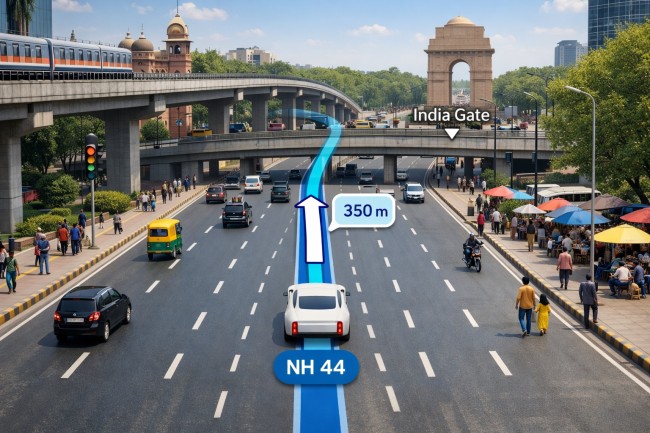
For nearly two decades, driving with Google Maps meant staring at a flat, cartoon-like 2D diagram of roads — colored lines on a gray background, with robotic voice prompts counting down meters. Functional, yes. Intuitive, not always.
Immersive Navigation changes the fundamental visual language of driving guidance.
What you now see on your screen:
Vivid 3D Views: Buildings, overpasses, bridges, and terrain appear as they actually look in the real world. The gap between your screen and your windshield is dramatically reduced.
Transparent Buildings: If a building is blocking your view of an upcoming turn or road curve, the building becomes translucent on your screen, so you can see the road continuing behind it. No more last-second lane swerves.
Granular Road Detail: The map now clearly displays individual lanes, crosswalks, traffic lights, and stop signs. You know exactly which lane to be in — well before you need to be in it.
Smart Zoom: The camera intelligently zooms in and out based on road complexity. On a highway, it stays wide. Approaching a tricky interchange, it tightens for precision.
Pre-Trip Destination Preview: Before you even start driving, you can preview your destination and surrounding area using Street View imagery. Maps will also recommend where to park and, as you approach, will highlight the building’s entrance and which side of the street it is on.
Real-Time Disruption Alerts: Powered by live community reports — over 10 million daily contributions — the system flags road construction, accidents, and closures along your specific route, not just in your region.
Route Trade-Off Intelligence: Choosing between routes is no longer guesswork. Maps now explains the actual trade-offs: “This route is 6 minutes longer but has no traffic.” “This route is faster but includes a toll.” You make an informed choice, not a blind one.
The voice guidance upgrade is subtler but remarkably important. Instead of the mechanical “In 500 meters, take the exit,” you now hear something human: “Go past this exit and take the next one for Illinois 43 South.” The difference sounds small. Cognitively, while driving in an unfamiliar city at night in the rain, it is enormous.
What powers the visuals? Gemini AI models work continuously behind the scenes, analyzing fresh imagery from Street View cameras and aerial photography to ensure what you see on screen closely matches what is actually outside your window. Landmarks, medians, construction changes — the system updates its visual model from the real world, not just static map data.
The CarPlay and Android Auto angle: Immersive Navigation is confirmed to be expanding to Apple CarPlay, Android Auto, and cars with Google built-in. This matters for business travelers and frequent commuters who live in their cars — high-quality 3D navigation will soon display on in-car screens, not just phones.
The Bigger Picture: Why This Update Is a Strategic Masterstroke
Google is not just improving a navigation app. It is executing a carefully considered strategy to make Maps the default decision-making tool for physical-world choices — where to eat, where to park, what route to take, where to stop on a road trip.
Every query that goes through Ask Maps is a signal. Every recommendation clicked, every reservation booked, every saved place — these are all rich behavioral data points that make the personalization engine smarter and more valuable. The more you use it, the better it gets. The better it gets, the more you use it. That is a powerful flywheel.
For businesses, the implications are significant. Being recommended by Ask Maps — rather than just appearing in a keyword search — is a fundamentally different type of visibility. It means a business isn’t just being found; it is being endorsed by an AI that has read thousands of its reviews, analyzed its photos, assessed its busyness patterns, and matched it to a specific user’s taste profile in real time.
Google Maps VP Miriam Daniel stated that the team’s goal was to remove the guesswork from trips entirely. With Ask Maps and Immersive Navigation working together, they have come remarkably close to that goal.
Availability: Who Gets It and When
Ask Maps: Rolling out now in the United States and India on Android and iOS. Desktop version coming soon.
Immersive Navigation: Rolling out now across the United States on iOS and Android. Expanding over the coming months to CarPlay, Android Auto, and vehicles with Google built-in. India and further global regions to follow.
One Final Thought
Twenty years ago, printed maps were replaced by GPS devices. Ten years ago, standalone GPS units were replaced by smartphone apps. What we are watching now is the next transition: the dumb navigation app being replaced by an intelligent spatial assistant.
Google Maps is no longer just telling you how to get somewhere. It is helping you decide where to go, why to go there, what to expect when you arrive, and how to get in the door — all in one seamless conversation.
The map has always been a mirror of the world. Now, for the first time, it is starting to think about it.