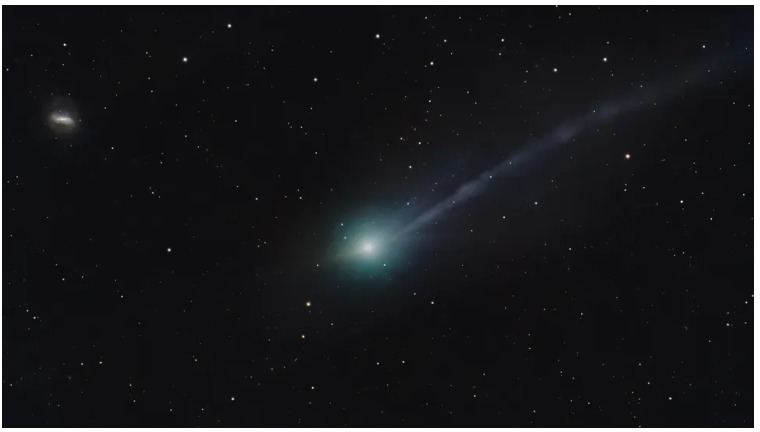

Space Desk, Dec 19 : In a milestone for interstellar exploration, the 3i/ATLAS Interstellar Comet successfully completed its closest flyby of Earth today, Friday, December 19. At approximately 11:30 AM, the celestial visitor reached its perigee at a distance of 168 million miles (270 million kilometers) from our planet before beginning its long journey into the deep reaches of space.
However, as the object recedes from our solar system, it leaves behind a wake of scientific mystery. Data collected during the transit has sparked intense debate among the global astronomical community regarding the object’s true identity.
A Catalog of Anomalies
While initially classified as a comet, analysts suggest that 3i/ATLAS exhibited “non-traditional” behaviors that defy standard gravitational models. To date, scientists have identified 18 distinct anomalies—ranging from unusual acceleration patterns to unexpected surface reflectivity.
These irregularities have led some experts to hypothesize that the object may not be a purely natural phenomenon. The findings echo the global fascination surrounding ‘Oumuamua, the first interstellar interloper discovered in 2017, but with even more complex data points to reconcile.
“The data we’ve gathered raises more questions than it answers,” noted one lead analyst. “From its origin to its structural behavior, 3i/ATLAS does not fit the profile of any comet or asteroid we have previously documented.”
What We Know So Far:
Closest Approach: 11:30 AM (Friday, Dec. 19).
Distance: 270 million kilometers (roughly 1.8 AU).
Current Status: Departing the inner solar system toward interstellar space.
Primary Concern: 18 physical and behavioral anomalies suggesting potential non-natural origins.
As the object moves beyond the reach of our most powerful telescopes, researchers are now racing to process the remaining telemetry, hoping to unlock the secrets of this mysterious voyager from beyond the stars.
Why 3I/ATLAS Is Unlikely to Be a Typical Natural Object
The discovery of 3I/ATLAS, the third known interstellar object detected passing through our Solar System, has attracted global scientific attention. This interest is not only because the object originated beyond our stellar neighborhood, but also because it displays a combination of characteristics that challenge conventional explanations for naturally occurring celestial bodies.
A Confirmed Interstellar Origin

One of the most striking features of 3I/ATLAS is its hyperbolic trajectory, which indicates that it is not gravitationally bound to the Sun. This confirms that the object entered the Solar System from deep interstellar space rather than forming alongside planets, asteroids, or comets within it. Such objects are extremely rare, with only two previously confirmed cases: Oumuamua in 2017 and 2I/Borisov in 2019.
Unlike typical interstellar comets, 3I/ATLAS does not display expected physical behavior such as visible outgassing, a dust coma, or a classic icy composition when exposed to solar radiation. The absence of these features raises important questions about whether the object follows the same natural processes observed in known cometary bodies.
An Extraordinary and Precise Trajectory

Perhaps the most astonishing aspect of 3I/ATLAS is the sequence of its movement through the Solar System. The object entered from interstellar space on a calculated hyperbolic path, approached the Sun closely and gained gravitational acceleration, passed near Mars, continued toward Earth, and is now predicted to gain a massive increase in speed through a future flyby of Jupiter on March 2026 next year , the most massive planet after the Sun.
This journey closely resembles a gravity-assist maneuver, a technique commonly used by human spacecraft to gain speed and momentum without consuming fuel. While gravity assists can occur naturally, it is extremely rare for an interstellar object to follow a path that efficiently exploits multiple gravitational encounters in such a precise sequence.
Can Such a Journey Be Random?
Scientists acknowledge that gravitational assists can happen by chance. However, the likelihood of an interstellar object entering the Solar System at exactly the right angle, surviving a close pass near the Sun without breaking apart, aligning with the inner planets, and finally exiting via Jupiter with maximum acceleration is statistically low.
This has led some researchers to suggest that current natural models may be incomplete when explaining objects like 3I/ATLAS. Although there is no direct evidence to support claims of an artificial origin, the object’s behavior does not fit neatly within established asteroid or comet classifications.
What Science Says and What It Does Not
Mainstream astronomy has not confirmed that 3I/ATLAS is artificial in nature. Scientists continue to investigate alternative natural explanations, including exotic compositions, unusually compact or dense materials, or objects shaped by extreme stellar environments before entering interstellar space.
At the same time, many researchers agree on one point: 3I/ATLAS is not a typical natural object, and its motion and physical characteristics cannot be fully explained using existing models alone.
A Challenge to Our Understanding
Rather than serving as proof of extraterrestrial technology, 3I/ATLAS highlights the limits of current astrophysical knowledge. It emphasizes how little is known about interstellar debris and how much remains to be discovered beyond our Solar System.
Whether 3I/ATLAS ultimately proves to be a rare natural anomaly or something that reshapes scientific understanding, it stands as a reminder that the universe continues to surprise us and that scientific progress comes from questioning the unexpected rather than dismissing it.