
Ichikawa, 22 Feb : The heartbreaking and inspiring story of Punch, the baby macaque who taught the world that the need for love is universal.
A Life That Began in Silence
On July 26, 2025, a tiny macaque was born at Ichikawa City Zoo in Japan. He weighed just 500 grams — barely more than a can of soup. The zoo staff named him Punch. And from his very first breath, life asked more of him than it should have asked of something so small.
His mother, a first-time parent, rejected him immediately after birth. No one can say exactly why — animal behavior rarely offers clean explanations. What we know is this: in the moment when Punch needed warmth the most, he was left alone in the cold. The bond that every infant primate is born needing, that unspoken contract written into their very biology, was broken before it could ever begin.
In the wild, baby macaques cling to their mother’s fur around the clock. It is not merely for warmth — it is survival. That physical closeness regulates their heartbeat, calms their nervous system, and tells them, without words, that they are safe. Without it, the psychological impact can be deep and lasting, scars that don’t always show on the outside.
The People Who Refused to Look Away
Two young zookeepers stepped in. Kosuke Shikano, 24, and Shumpeii Miyakoshi, 34, took Punch under their care and did something remarkable — they didn’t just keep him alive. They tried to give him a reason to live.
They bottle-fed him milk, wrapped him in soft cloth, and sat with him through the hours that felt longest. They couldn’t replace his mother. No one could. But they showed him, in the only language that matters to a newborn, that he was not invisible. That someone had noticed him, and chosen to stay.
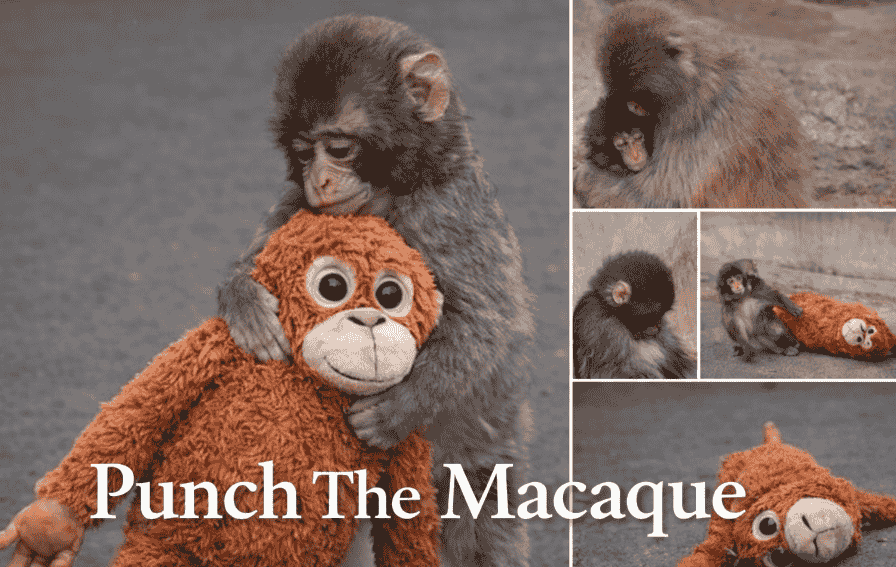
To help him feel grounded, his caregivers also gave him towels and soft toys to cling to — a gentle substitute for the fur he never got to hold. That is how Punch found the orange plush toy that would change everything.
One Small Toy. One Very Big Love.
The toy was a soft orangutan plush — round-faced and floppy-limbed, the kind you’d find at any gift shop. But to Punch, it became his whole world.
He carries it everywhere. He wraps his small arms around its fur while he sleeps, gripping tighter when unfamiliar sounds startle him awake. When nervous zookeepers attempted to introduce him to other macaques, Punch held the toy close like a lifeline. Even exploring the corners of his enclosure, he brings it along — never out of arm’s reach, never left behind.
Videos of Punch clutching his plush friend spread quickly across social media, gathering millions of views under the hashtag #HangInTherePunch. People watched through tears. And most of them couldn’t explain exactly why it hit so hard — only that it did. Perhaps because in that small, trembling grip, they recognised something deeply human: the desperate, beautiful need to hold onto something when the world feels too big and too cold to face alone.
Progress, Setbacks, and the Long Road to Belonging
For a while, hope grew. Caregivers reported that Punch was slowly making attempts to connect with the other monkeys in his enclosure. He was curious, cautious, but trying. The world cheered. Many believed his story was finally turning the corner — from loneliness to belonging.
Then new footage surfaced. It showed Punch being pushed away and bullied by other macaques — animals who had grown up within natural social bonds that he had never experienced. For those who had been following his journey, the videos felt like a gut punch. The fragile progress, so hard-won, suddenly seemed even more precarious.
And yet — he keeps trying. That may be the most quietly extraordinary thing about Punch. He has every reason to withdraw completely, to turn inward and never reach out again. Instead, he keeps showing up. Toy in hand, eyes wide, still looking for a place where he fits.
More Than a Viral Moment
Punch’s story has sparked genuine, important conversations about the welfare of captive primates. These are not props or attractions — they are emotionally complex, deeply social beings who depend on family structures for their mental and physical health. When those bonds are severed, the damage doesn’t disappear simply because a toy is provided or a caretaker is kind.
Animal welfare advocates are calling for stronger rehabilitation protocols in zoos worldwide — including family reunification programmes, structured social integration, and long-term psychological monitoring for infants who experience early maternal rejection. Punch’s quiet suffering has put a face, and a name, on an issue that was too easy to overlook.
There is something in his story that cuts through every language and cultural barrier. The need to be held. The longing to belong somewhere. The courage — if we can call it that in a six-month-old macaque — to keep reaching out even after being turned away.
Still Waiting. Still Hoping.
As of today, Punch continues to live at Ichikawa City Zoo. He is growing. He still carries his plush orangutan everywhere he goes.
The world is watching — not because it is entertained, but because it is genuinely rooting for him. Because somewhere in that small, determined grip on a stuffed toy, Punch is holding something that belongs to all of us: the belief that love, even when it arrives late and in unexpected forms, is always worth reaching for.
Hang in there, Punch. 🧡