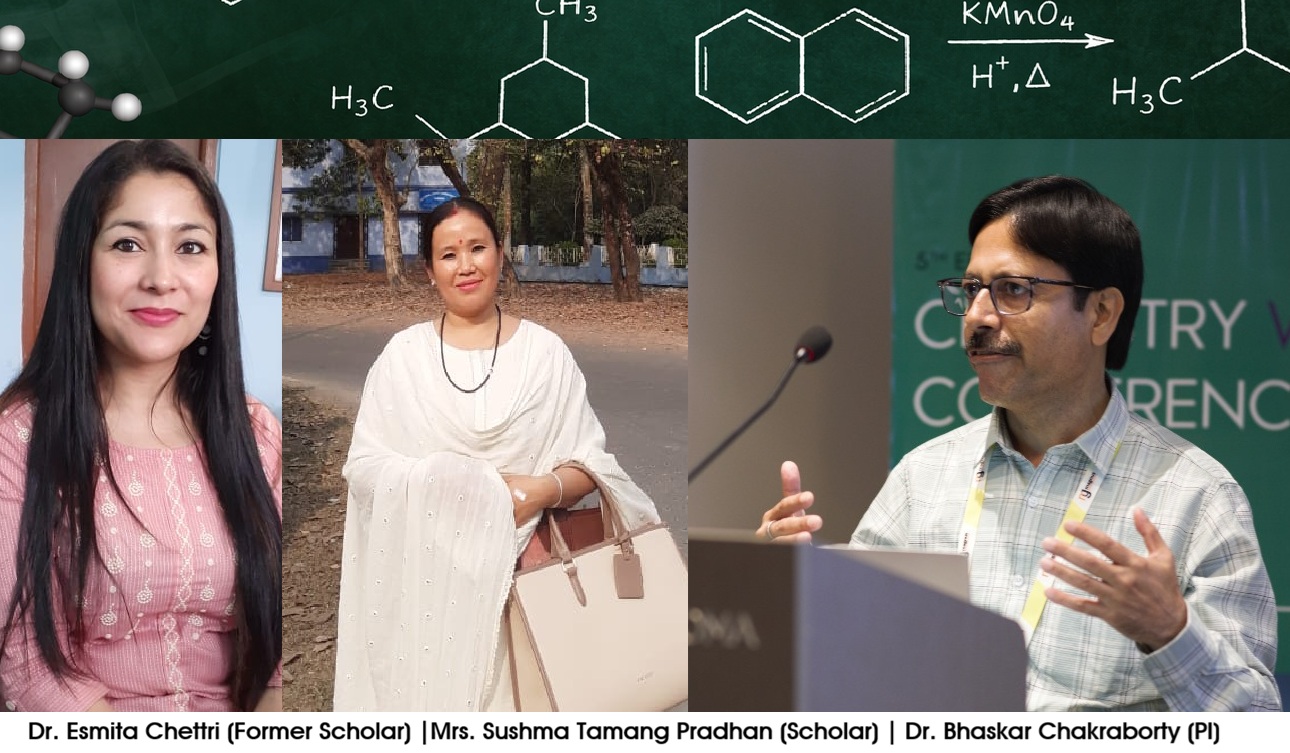
Gangtok, April 8 : A team led by Prof. Dr. Bhaskar Chakraborty of Sikkim Government College has pioneered a solvent-free, ball-milling synthesis of fluorinated dipeptides — molecules showing early but striking anticancer potential — in a dual paper published in one of chemistry’s most prestigious indexed journals.
At a Glance
| Published | Indian Journal of Heterocyclic Chemistry, Vol. 36, No. 01 (2 April 2026) |
| Indexing | Scopus (Elsevier) WOS (Web of Science) |
| Research Team | Dr. Bhaskar Chakraborty (PI) · Mrs. Sushma Tamang Pradhan (Scholar) · Dr. Esmita Chettri (Former Scholar) |
| Institution | Organic Chemistry Laboratory, Sikkim Government College (NBBDC), Gangtok, Sikkim, India |
| Key Innovation | Solvent-free ball-milling SPPS; CDMT coupling reagent replacing DCC; faster yields, no insoluble byproduct |
| DOI References | 10.59467/IJHC.2026.36.17 & 10.59467/IJHC.2026.36.53 |

In a landmark pair of research papers published just days ago in the Indian Journal of Heterocyclic Chemistry — a journal indexed in both Scopus (Elsevier) and the Web of Science (WOS) — chemists from a government college in the Himalayan state of Sikkim have unveiled a novel, environmentally conscious approach to synthesising fluorinated compounds that could lay the groundwork for a new generation of anticancer medicines.
The work, led by Prof. Dr. Bhaskar Chakraborty of the Organic Chemistry Laboratory at Sikkim Government College (NBBDC), Gangtok, introduces a solvent-free, mechanochemical procedure — deploying a ball-milling technique — to produce fluorinated dipeptides and their precursor fluoronitrones more efficiently than existing methods. The significance of this cannot be overstated: traditional peptide synthesis relies on coupling reagents like dicyclohexylcarbodiimide (DCC), which generate problematic insoluble byproducts and demand tedious purification steps. Dr. Chakraborty’s team replaces DCC with a cleaner reagent — 2-chloro-4,6-dimethoxy-1,3,5-triazine (CDMT) — cutting reaction time, boosting yields, and sidestepping the byproduct problem altogether.
“Preliminary studies have shown that a few dipeptides exhibit anticancer activities — and our further research may lead to the development of many new anticancer drugs in coming days.”
— Dr. Bhaskar Chakraborty, Corresponding Author & Principal Investigator
Peptides — short chains of amino acids — are the fundamental building blocks of proteins and play essential roles in immune function, cell signalling, and hormonal regulation. The strategic introduction of fluorine atoms into these molecules is known to dramatically alter their biological behaviour: fluorine’s high electronegativity, its strong C-F bond, and its near-identical atomic size to hydrogen allow it to slip into biological systems in unexpected ways, enhancing stability and bioactivity.
The second paper extends this chemistry further, reporting the synthesis and 1,3-dipolar cycloaddition reactions of N-substituted-4-(trifluoromethyl)-C-phenylnitrones — stable, isolable compounds unlike most nitrones described in existing literature — to produce fluoro-cycloadducts with demonstrated anticancer activity. This class of compounds, the fluoroisoxazolines, is increasingly attracting attention in both synthetic and pharmaceutical chemistry.
The collaborative nature of this research reflects the kind of cross-institutional effort that frontier chemistry demands. The team has acknowledged critical support from the Indian Association for the Cultivation of Science (IACS), Kolkata; Jadavpur University, Kolkata; the Department of Microbiology (Pharmaceutical Sciences); and the CSIR-Central Drug Research Institute (CDRI) in Lucknow — one of India’s premier drug discovery institutions.
CDRI’s involvement signals that the biological activity data behind these fluorinated compounds is being taken seriously at the highest levels of India’s pharmaceutical research infrastructure. The institute has a storied history of contributing to drug discovery, and its pairing with a Himalayan academic laboratory underscores the collaborative, pan-India spirit of this project.
What makes this research especially compelling for the broader scientific community is its adherence to greener chemistry principles. By eliminating solvents and hazardous byproducts, the ball-milling mechanochemical route aligns with global imperatives to reduce the environmental footprint of pharmaceutical synthesis — making it not merely scientifically significant, but timely.
The team reports that research is actively continuing, with further applications of these fluorinated scaffolds on the horizon. If subsequent studies confirm and expand the anticancer data already in hand, the work emerging from a government college in the Sikkim hills may prove to be one of Indian chemistry’s most consequential contributions of the decade.
The research team gratefully acknowledges the support of: IACS (Indian Association for the Cultivation of Science), Kolkata · Jadavpur University, Kolkata · Department of Microbiology (Pharmaceutical Sciences) · CSIR-Central Drug Research Institute (CDRI), Lucknow — in addition to the Organic Chemistry Laboratory, Sikkim Government College (NBBDC), Gangtok.
Fluoro-dipeptides
Fluorine-containing two-amino-acid chains with enhanced bioactivity, stability, and potential anticancer properties.
Ball-milling (SPPS)
A solvent-free, mechanochemical method that grinds reactants together for a faster, greener synthesis without harmful solvents.
CDMT Reagent
A cleaner coupling reagent replacing DCC; avoids insoluble byproducts and improves yield in peptide synthesis.
Fluoroisoxazolines
5-membered heterocyclic compounds with fluorine substituents; increasingly prominent in pharmacology and anticancer research.
1,3-Dipolar Cycloaddition
A powerful ring-forming reaction used to build complex cyclic molecules from nitrones and activated olefins or alkynes.