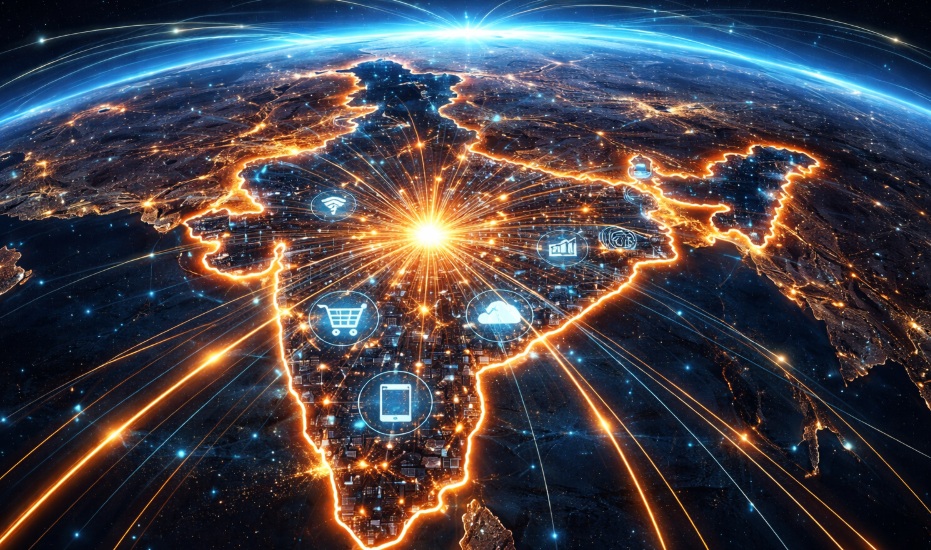

India’s digital economy, one of the world’s most ambitious and fast-growing, rests on a surprisingly fragile foundation — American technology. As Iran’s conflict with the United States escalates into infrastructure warfare, the country’s 1.4 billion people stand at a crossroads they never expected to occupy.
Analysis Desk | April 1, 2026
The War Nobody Expected to Affect Your Phone
On the 33rd day of what analysts are calling the most consequential conflict in the Middle East since the Second World War, Iran’s Islamic Revolutionary Guard Corps (IRGC) did something that most military strategists had long theorised but few imagined would materialise with such clinical precision — it turned a battlefield grievance into a technology chokehold. By formally designating 18 American corporations as legitimate military targets and following through with drone strikes on Amazon Web Services infrastructure in Bahrain, Tehran delivered a stark message: the next front in modern warfare is not territory, it is the invisible architecture that runs the world.
For most Indians, the word ‘war’ conjures images of tanks, borders and diplomatic corridors. But in 2026, the more accurate image is a data centre going dark — and with it, the UPI payment that didn’t go through, the ATM that returned an error, the boarding pass that couldn’t be scanned. That is the new face of geopolitical disruption, and India, for all its homegrown digital ambition, is more exposed to it than most of its policymakers would care to admit.
What Iran Actually Did — And Why It Matters
On April 1, 2026, the IRGC struck a Batelco communications facility in Bahrain that hosts Amazon Web Services infrastructure, rendering it inoperable. This was not a first strike. Iranian drones had already hit three AWS data centres in the UAE and Bahrain in early March. With each attack, Tehran refined its doctrine: not the destruction of armies, but the degradation of the economic sinews that bind the US-aligned world together.

The IRGC’s official target list names 18 American corporations: Microsoft, Google, Apple, Meta Platforms, Intel, Boeing, Oracle, IBM, Cisco Systems, Tesla, JPMorgan Chase, Dell Technologies, Hewlett-Packard, and General Electric, among others. Additionally, The Register reported that Iran’s state-affiliated Tasnim news agency released a second, expanded list identifying 29 specific facility locations across Bahrain, Israel, Qatar and the UAE — five Amazon sites, five Microsoft, six IBM, three Palantir, four Google, three Nvidia and three Oracle buildings. The language used by IRGC spokesperson channels was unambiguous: these are not warnings, they are operational designations.
The stated justification is that these companies’ AI and information technology systems are being used by US and Israeli forces to plan and track assassination targets inside Iran. Whether or not that claim is verifiable, the strategic logic behind it is not irrational. In an era of precision warfare, targeting intelligence infrastructure is as militarily meaningful as targeting a missile battery.
India’s Digital Miracle Was Built on American Foundations
India’s transformation over the past decade into a global digital economy success story is genuinely remarkable. As of January 2026, UPI processed over 21.70 billion transactions worth more than Rs 28.33 lakh crore in a single month — making it the world’s largest real-time payments platform by volume. The digital economy contributed approximately 11.74 per cent of GDP in FY2022-23 and is projected to reach 20 per cent of gross value added by 2029-30. Over 144 crore Aadhaar numbers have been generated, and 85.5 per cent of Indian households now own smartphones.
But here lies the uncomfortable paradox: this indigenously branded revolution runs, in significant measure, on foreign — primarily American — rails. India has been extraordinarily good at building applications and interfaces. It has been significantly less successful at owning the core technology stacks beneath them. The servers, the networking hardware, the enterprise software, the cloud layers — these belong, overwhelmingly, to the same companies now sitting on Iran’s target list.
Oracle’s Flexcube platform powers the core banking systems of some of India’s most systemically important financial institutions, including HDFC Bank, Yes Bank, Canara Bank and the State Bank of India. These are not peripheral applications. Flexcube handles the fundamental ledger operations that determine whether your salary arrives, whether your EMI deducts correctly, whether a business can pay its suppliers. A serious disruption to Oracle’s service availability, even temporarily, would cascade through the financial system in ways that are difficult to contain.
Microsoft Azure hosts the backend infrastructure that multiple Indian banks rely on to process UPI transactions. Google Pay — one of the three dominant UPI apps used by hundreds of millions of Indians — operates within Google’s cloud and authentication ecosystem. WhatsApp, the primary digital communication tool for a vast portion of India’s working population and a growing channel for business transactions, is a Meta product. Meta is on the list.
The Network Layer: Cisco’s Quiet Dominance
Perhaps the most underappreciated dimension of India’s US technology dependency is at the network layer — the hardware that actually moves data between devices, servers and users. Cisco Systems controls approximately 60 per cent of India’s enterprise switches and around 63 per cent of enterprise routers. Telecom operators Jio and Airtel — whose combined subscriber base exceeds 800 million — run substantial portions of their network infrastructure on Cisco equipment. Corporate networks, government agency data centres, hospital systems, stock exchange connectivity, airport Wi-Fi networks — all lean heavily on Cisco’s hardware and software.
A cyber attack or physical degradation of Cisco’s global service infrastructure, or an enforced sanctions-related supply disruption, would not simply slow India’s internet. It would segment it. Entire regions of the country, specific enterprise verticals, or critical public sector systems could become isolated from each other and from global networks. The downstream consequences — for commerce, for healthcare, for governance — are difficult to overstate.
This dependency is not accidental. As Cisco has noted in its own published materials, the company has spent years building deep roots in India’s digital ecosystem, collaborating with airports, hospitals, universities and government bodies. Its manufacturing facility in Chennai is a recognition of how central India has become to its growth story. The relationship is mutually beneficial — but it is also a single point of fragility in a crisis scenario.
Aviation, Semiconductor Supply and the Invisible Chip
Beyond the immediately visible digital layer, Iran’s target list carries implications for India’s physical infrastructure aspirations as well. Boeing’s presence on the list is directly relevant to India’s aviation expansion story. Air India has placed firm orders for 220 Boeing aircraft as part of its fleet modernisation drive, while Akasa Air has committed to 150 Boeing 737 MAX aircraft. A prolonged disruption to Boeing’s operational capacity — whether through physical attacks on its Middle Eastern facilities, cascading insurance and financial complications, or supply chain dislocations — could delay deliveries, increase financing costs, and add to the operational uncertainty already created by global fuel price volatility from the Strait of Hormuz closure.
At the chip level, Intel’s processors power the overwhelming majority of laptops, desktops and servers deployed across Indian enterprises, government bodies and educational institutions. This is not a problem that can be solved by switching vendors overnight. The installed base of Intel-dependent systems in India runs into hundreds of millions of units. A serious supply disruption — even without any physical attack on Indian soil — could throttle India’s IT services sector, which employs approximately 5.4 million people and generates over $220 billion in annual export revenues.
General Electric, also on the list, has deep integration into India’s power generation sector. GE turbines and GE Vernova equipment are used across multiple Indian power plants, and GE Aviation engines are used on several aircraft in Indian fleets. The interconnectedness is not dramatic — it is quiet, technical and systemic.
A Strategic Wake-Up Call India Has Heard Before — And Not Fully Heeded
What makes this moment particularly pointed for Indian policymakers is that it is not entirely new terrain. In 2018-2019, when the Trump administration imposed secondary sanctions on Iran, India was effectively compelled to halt imports of Iranian crude oil. At its peak, India was importing approximately 23-25 million tonnes of Iranian oil annually, making Iran one of its top three suppliers. The overnight switch to alternative suppliers — primarily from the Gulf, the US and Russia — cost Indian refiners hundreds of millions of dollars in price adjustments and logistical pivots. The lesson that US foreign policy decisions can create binding economic constraints for India was written clearly. It was not fully absorbed.
Today, India finds itself in an even more structurally embedded position. Oil can be rerouted over months. Digital infrastructure cannot be replaced in years. The question of technological sovereignty — how much of the infrastructure that runs your economy should be controlled by foreign entities — is not new. China answered it brutally in 2017 with its cybersecurity law and its systematic displacement of Western technology from critical sectors. India has moved in a different direction, choosing integration and partnership over autarchy. That has produced enormous economic benefits. It has also produced the vulnerability now starkly visible on Iran’s target list.
India’s Digital India programme and the broader DPI framework — Aadhaar, UPI, ONDC, DigiLocker — are genuinely indigenous in their design, governance and regulatory architecture. But they are not indigenous in their compute, network and enterprise software layers. The government’s IndiaAI Mission, which is deploying over 34,000 GPUs by 2025, is a step toward compute self-reliance. The semiconductor policy — including proposed fab incentives and the push to develop domestic chip design capability — addresses the longer-term structural issue. But these are decade-long projects. The vulnerability exists today.
The Scenario No One Wants to Model
It is worth being clear about what is and is not being claimed here. Iran’s current attacks are focused on data centre and technology company facilities in the Middle East — Bahrain, UAE, Qatar, Israel. There is no direct attack on Indian infrastructure. Indian systems are not under fire. What exists is a chain of dependencies through which disruption abroad propagates to disruption at home.
But the scenario that Indian strategic planners must now consider goes beyond the current conflict. The Iran war has demonstrated that technology infrastructure can become a theatre of military operations. It has demonstrated that a mid-tier state actor is willing and capable of targeting the specific facilities that run the global digital economy. And it has demonstrated — through the Strait of Hormuz closure and the resulting global fuel crisis — that cascading economic effects from a regional conflict can reach every economy on earth within weeks.
The more uncomfortable version of this question is not about Iran specifically. It is about what would happen if US-India relations deteriorated — a scenario India has navigated carefully for decades but cannot entirely eliminate from its risk calculus. American technology companies are cooperative, commercially motivated partners. They are not instruments of Indian state policy. In a scenario of serious bilateral strain, that distinction matters enormously.
This is not alarmism. It is the same strategic logic that has driven India’s long-standing policy of non-alignment, its refusal to join Western sanctions regimes wholesale, and its insistence on maintaining energy, trade and security relationships across competing blocs. The digital dimension of that strategic autonomy has simply not received the same sustained attention as the energy, military or diplomatic dimensions.
What India Should Be Doing — And Partly Already Is
A balanced assessment requires acknowledging that India is not passive on these questions. The government’s push for domestic semiconductor manufacturing, its investment in indigenous AI models like BharatGen and Sarvam-1, its development of DIGIPIN and other homegrown infrastructure layers — these reflect an awareness that digital sovereignty matters. The RBI’s ongoing efforts to diversify the technology vendors underpinning critical financial market infrastructure are another indicator of institutional awareness.
But several gaps remain. First, India lacks a formal Technology Resilience Framework — an equivalent of its energy security planning that maps critical digital dependencies, assigns risk ratings, and mandates contingency plans at the institutional level. Second, the concentration of core banking software in a single vendor (Oracle’s Flexcube) is a structural risk that deserves explicit regulatory attention. Third, the question of data centre geography — whether India’s most critical digital infrastructure is physically located inside Indian borders and therefore outside the reach of both foreign attacks and foreign legal compulsion — deserves a more urgent policy answer than it has received.
Finally, the Iran crisis is a reminder that India’s diplomatic posture of strategic ambiguity — refusing to take sides in great power conflicts — must be complemented by a digital posture of strategic resilience. You can choose not to sanction Russia. You cannot choose to be unaffected if the servers that process your financial transactions go offline because they are located in a war zone.
The Bottom Line
India’s extraordinary digital transformation has created genuine prosperity, inclusion and global recognition. It has also created a set of structural dependencies that are now visible in ways that are, frankly, uncomfortable. The Iran-US conflict did not create this vulnerability — it merely illuminated it. The question for India’s policymakers, technology sector and strategic community is whether this illumination will produce a calibrated, sustained response, or whether the light will fade when the immediate crisis passes, leaving the structural work undone.
For the average Indian — the person who pays for groceries via UPI, checks their bank balance on a Microsoft Azure-hosted app, communicates with family on WhatsApp, and flies on a Boeing aircraft — the connection to a war in the Persian Gulf may feel impossibly remote. But the cables are shorter than they appear. In a digital economy, geography is not destiny. Dependency is.