
Gangtok, 11 Feb : The Public Health Engineering (PHE) Department on Tuesday briefed the media on the growing water crisis affecting the region, attributing the situation to an unusually harsh winter and a sharp decline in rainfall.
The press conference was led by PCE-cum-Secretary of PHE, Shailendra Sharma, in the presence of Chief Engineer Pema Donka, Additional Chief Engineer Sonam C. Lepcha, Superintending Engineer Yeshey Dorjee, Divisional Engineer Pushpa Sharma, and Assistant Engineer Archana Lama.
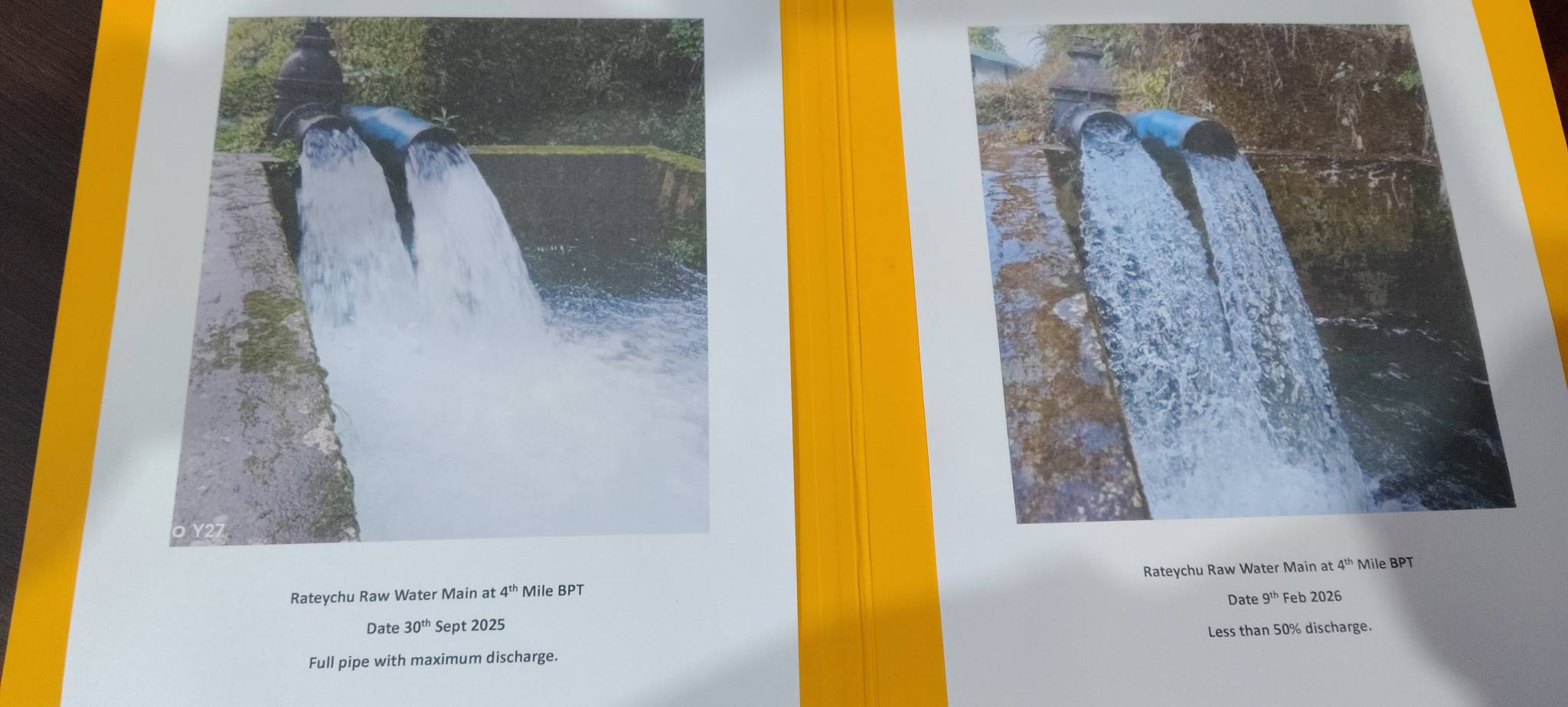
Addressing reporters, Sharma explained that the prolonged dry spell and inadequate precipitation have significantly reduced the recharge of natural water sources. He noted that climate change and global warming have contributed to the adverse weather conditions. Compared to September 2025, water discharge levels across the state have dropped by nearly 50 to 60 percent.
With the Rateychu River — the primary water source for Gangtok — witnessing severe depletion, authorities have decided to restrict water supply to once a day to ensure fair distribution among consumers. The department will soon issue a public service announcement detailing revised supply timings for different localities. Sharma also clarified that, as per Government of India norms, the storage capacity of the existing water supply system is capped at 30 percent.
The department has urged commercial establishments to limit water usage and avoid wastage. Despite drawing water within permissible ecological limits to safeguard aquatic life, the high rate of consumption has made twice-daily supply unfeasible. Households, particularly those in lower-altitude areas that tend to receive comparatively higher volumes, have been advised to install ballcocks and float valves in storage tanks to prevent overflow.
Officials warned that violations involving water wastage would attract penalties under Sections 7, 8, and 15 of the Water Supply and Water Charges Act, 2025.
In a long-term measure, the Bhusuk River is being developed as an alternative water source with financial support from the Asian Development Bank. The project is reportedly in an advanced stage, with tendering expected to commence by March. If operationalised, the Bhusuk source could cater to areas below Tadong, allowing the Rateychu supply to be reserved for Gangtok and higher elevations, thereby improving overall distribution efficiency.
During the briefing, officials also presented photographic evidence from the Rateychu intake point, illustrating the stark contrast in water levels between September 2025 and February 2026.
The department concluded by appealing to residents to cooperate and adopt responsible water usage practices during the ongoing crisis.
PUBLIC NOTICE FROM PHED , Dated 11 Feb 2025
Depletion of Water Sources
Esteemed citizens are aware that this winter has been unprecedented. No significant precipitation has fallen between November 2025 and February 2026, leaving water sources across the State critically depleted. In previous years, intermittent rainfall during these months allowed marginal regeneration of sources; however, this season’s prolonged dry spell, compounded by the impacts of climate change, has sharply reduced water availability.
Discharge at water sources throughout the State has fallen by nearly 50 percent since September 2025, and a further decline is expected from March through May. Consequently, water supply can now be provided only once daily to serviced zones.
Since drinking water is the very basis of life, domestic use must take precedence. Commercial establishments are therefore appealed to marginally reduce their activities during this critical period. Curtailing wastage and excessive consumption is imperative, as continued dry conditions may lead to an acute shortage in the coming months.
The State Government has already taken cognizance of this serious issue. Under the directions of the Hon’ble Chief Minister, Shri Prem Singh Tamang, and the guidance of the Hon’ble Minister, PHED, Ven. Sonam Lama, a project under ADB funding for sourcing water from alternate sources from the Bhusuk Khola side is presently at an advanced stage to meet the city’s demand.
Meanwhile, the Public Health Engineering Department (PHED) has initiated several measures to optimize drawal from available sources. These include raising embankments at river intake points, plugging detected leakages, and issuing a public advisory vide Appeal dated 30.01.2026:
[https://www.facebook.com/share/p/1AVCXLeFB/?mibextid=wwXlfr]
All households are earnestly requested to adopt measures to avoid wastage of water. In particular, households whose storage tanks overflow due to higher differential pressure are requested to install float valves to ensure equitable water flow to houses with lower pressure. Any wastage detected shall invite strict action under Section 7 (Prohibition of pollution, wastage, misuse or disturbances in equitable distribution of water) of The Sikkim Water Supply and Water Charges Act, 2025, along with other relevant provisions.
Together, through responsible use and collective effort, we can safeguard this most vital resource and ensure equitable access to water for every household. This notice is issued in public interest.