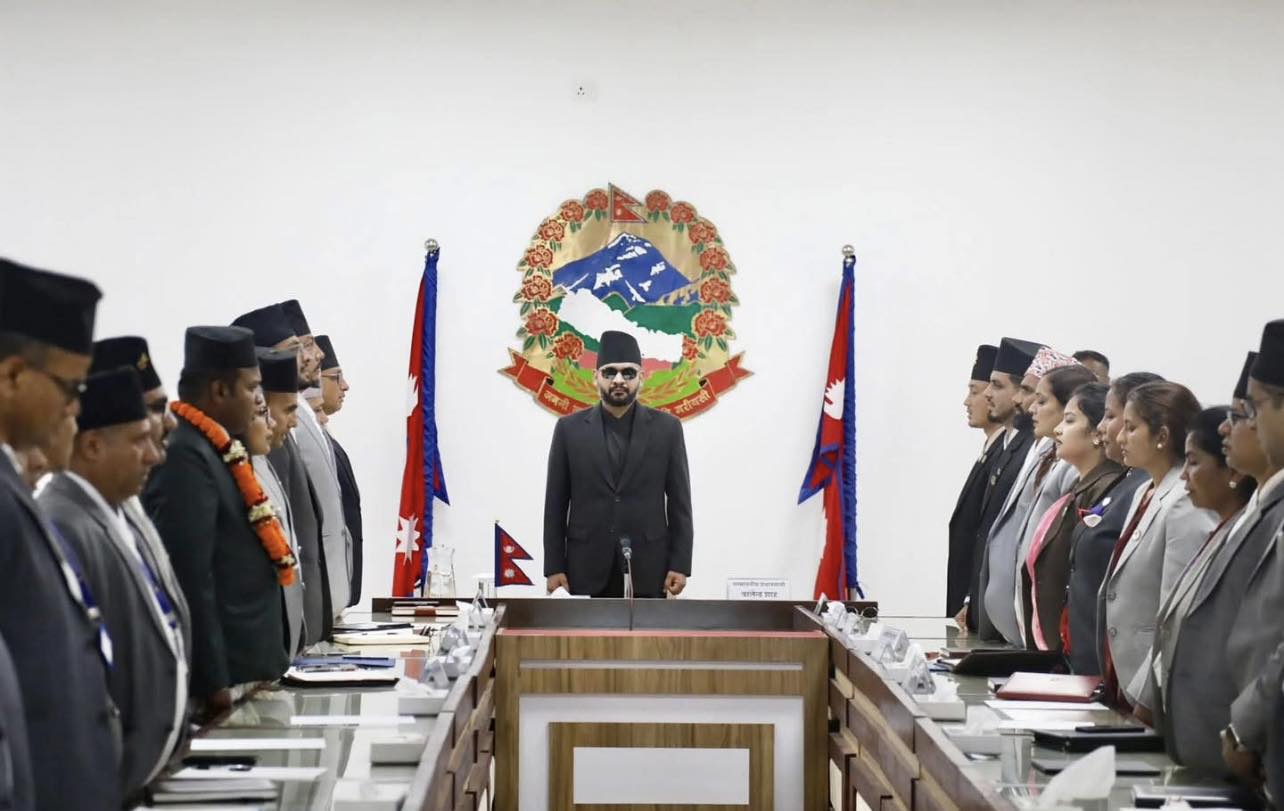

Kathmandu, March 27 : Nepal stepped into a fresh political phase on Friday as Balendra Shah, popularly known as Balen Shah, officially took the oath of office as the country’s Prime Minister. The ceremony, held in the presence of top leaders and dignitaries, was administered by President Ram Chandra Poudel, marking a major transition in national leadership.
Soon after assuming office, Prime Minister Shah unveiled his new Cabinet, blending seasoned politicians with emerging faces. The composition signals an attempt to combine experience with fresh momentum, with a clear focus on governance reform and efficiency.
Addressing the nation briefly, Shah underlined transparency, accountability, and people-centric governance as the pillars of his administration. He pledged to tackle long-standing issues, improve public services, and rebuild citizens’ trust in state institutions.
However, the tone of his leadership became even clearer during the first Cabinet meeting held at Singha Durbar. In a firm message to his ministers, Shah made it known that performance would be non-negotiable — those unable to deliver results should step aside.
He stressed the urgency of government work, urging ministers to act swiftly and responsibly. While expressing confidence in his team’s capability, he reminded them that public service must remain the top priority, with citizens at the heart of every decision.
Highlighting bureaucratic delays as a recurring challenge, the Prime Minister warned against using legal complexities as an excuse for inaction. Instead, he encouraged proactive solutions, including revising laws if necessary to ensure development projects move forward without hindrance.
Shah also advised his ministers to stay committed to ethical decision-making and not blindly follow flawed instructions. He emphasized that meaningful progress must continue under all circumstances.
Ending the meeting on a hopeful yet determined note, Shah shared his vision of building a “smiling Nepal,” reflecting his ambition for a fast-paced, results-oriented government.
With expectations running high across the country, the coming days will be crucial in determining how effectively the new leadership delivers on its promises.
Following the formation of the new government, members of Prime Minister Balendra Shah’s Cabinet took the oath of office and secrecy at Shital Niwas, marking the formal start of their responsibilities.
The Cabinet is largely made up of leaders from the Rastriya Swatantra Party (RSP), highlighting the party’s key role in the current administration. The selection of ministers was carried out under the leadership of RSP president Rabi Lamichhane in coordination with Prime Minister Shah.

Sudan Gurung has been appointed as Home Minister. He came into the national spotlight during the Gen Z movement through his NGO “Hami Nepal” and represents Gorkha-2. RSP vice-chair Swarnim Wagle has taken charge of the Finance Ministry, bringing his background in economics to the role.
Bikram Timilsina has been assigned the Ministry of Communication and Information Technology, while Shishir Khanal will handle Foreign Affairs. Khanal previously led the party’s foreign affairs department.
Ganesh Paudel has been given responsibility for Culture, Tourism and Civil Aviation. Dipak Sah will oversee Labour and Employment. Biraj Bhakta Shrestha has been appointed Minister for Energy, Water Resources and Irrigation.
Gita Chaudhary will lead the Agriculture and Livestock Development, Forests and Environment sectors. Sasmit Pokharel has been assigned Education, Science and Technology, along with Youth and Sports.
Sita Badi has taken charge of Women, Children and Senior Citizens. Sunil Lamsal will oversee Physical Infrastructure, Transport and Urban Development.
Nisha Mehata has been appointed Minister for Health and Population as well as Water Supply. Pratibha Rawal will handle Federal Affairs, General Administration, Land Management, Cooperatives and Poverty Alleviation.
Sobita Gautam has been given the Law, Justice and Parliamentary Affairs portfolio.
With the full Cabinet now in place, the government led by Prime Minister Shah moves forward with a mix of experienced leaders and new faces, as it begins work on its policy priorities and governance plans.