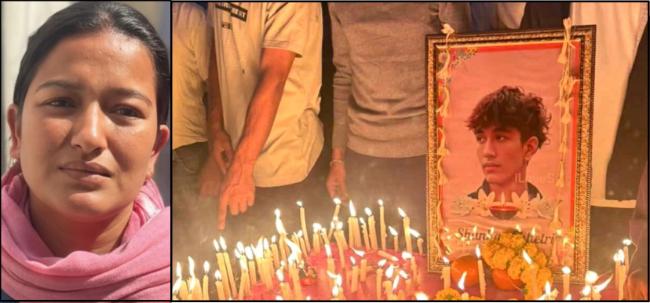

There is a particular cruelty to midnight tragedies — they strike when the world is asleep, and by morning, a family wakes up changed forever. That is precisely what unfolded on the darkened stretch of Sevoke Road near Panitanki Outpost in the early hours of Thursday, February 19, when a speeding car tore through the night and in a single violent moment, ended one life and shattered many others.
Shankar Chhetri., a gig delivery worker associated with Blinkit, was returning home after a night shift — a man doing what millions of India’s invisible workforce do every day: hustle quietly to keep a household afloat. He was walking along the roadside with a young woman when a recklessly driven vehicle ploughed into them without warning. The force of the impact was so severe that both victims were flung off the road. Shankar died on the spot. The young woman survived, but remains in critical condition. The driver, with a callousness that defies human decency, fled the scene without pause — vanishing into the city’s sleeping darkness.
A FAMILY LEFT WITHOUT A BREADWINNER, A CITY LEFT ASKING QUESTIONS

In the hours that followed, the grief was palpable and public. Shankar’s sister, Manu Chhetri, broke down before the media — her anguish raw, her words sharp with pain. Her brother, she revealed, was not just a delivery worker; he was the sole provider for their family. With his death, the household’s only financial pillar had crumbled. “We need justice,” she sobbed, her voice carrying the weight of a question that many across the country’s gig economy ecosystem understand all too well: who protects those who deliver for us, after they clock out?
Her grief, understandably, turned to anger. She accused the Siliguri Police of negligence, questioning how, in a city laden with surveillance infrastructure, a vehicle that had just killed a man could remain unidentified. Her public outcry became the voice of not just one family, but of an entire community watching justice seemingly stall while a perpetrator remained free.
THE MACHINERY OF JUSTICE MOVES — AND MOVES FAST
But justice, to its credit, did not sleep indefinitely.

Within 24 hours of the incident triggering public outrage, Siliguri Police launched an intensive, methodical operation. Investigators began systematically analysing CCTV footage from multiple locations across the city, retracing the vehicle’s movement frame by frame — a classic but effective forensic strategy that transforms a city’s surveillance grid into an investigative net.
The results were decisive. By February 23, authorities had identified and arrested the accused — Debanshu Pal Chowdhury, the son of a local petrol pump owner. The vehicle used in the crime was also seized and impounded. What had begun as a chase against anonymity ended with a name, an arrest, and a family’s first breath of relief in days.
The speed of resolution deserves acknowledgment. In a country where hit-and-run cases frequently drag on for weeks — or disappear entirely into the administrative fog — the Siliguri Police’s 24-hour turnaround reflects both commendable operational focus and, arguably, the catalytic pressure of public accountability. Manu Chhetri’s public appeal, far from being a lament into the void, became the moral urgency that kept the investigation from losing momentum.
THE BIGGER PICTURE: PRIVILEGE, THE ROAD, AND THE GIG WORKER’S VULNERABILITY

This case, however, is more than a crime-and-justice narrative. It is a mirror held up to a structural reality that India’s rapidly expanding gig economy has not yet adequately addressed.
Shankar Chhetri. was part of a growing army of delivery professionals who operate in the margins of time — late nights, early mornings, odd hours — to meet the 10-minute delivery promises that have become the hallmark of quick commerce platforms like Blinkit, Zepto, and Swiggy Instamart. These workers are the human infrastructure behind the convenience economy. Yet they commute on the same roads as reckless drivers, often without company-provided safety gear, accident insurance parity, or institutional accountability in the event of injury or death.
The accused, in contrast, is the son of a business owner — a detail that speaks to a pattern India’s urban road fatality data repeatedly confirms: late-night reckless driving is disproportionately associated with privilege and impunity. The instinct to flee — rather than stop, call for help, and take responsibility — is not merely a character failure. It is the product of a belief, often validated by experience, that consequences can be outrun.
They could not be, this time.
WHAT THIS CASE DEMANDS GOING FORWARD
The arrest of Debanshu Pal Chowdhury is a necessary first step, but it cannot be the last word. Several questions demand institutional attention.
The young woman injured in the same incident remains in critical condition. Her recovery — medical, financial, and psychological — requires structured support, not just police case closure. Gig platforms must urgently revisit the welfare architecture for their delivery partners, including accident insurance, night-shift safety protocols, and family support mechanisms when a worker is fatally injured on duty. Urban traffic enforcement must be strengthened on high-risk corridors like Sevoke Road, particularly during late-night hours when both pedestrian vulnerability and driver recklessness tend to peak. The legal proceedings against the accused must be pursued with rigour. An arrest is not justice — conviction and sentencing are.
A CITY THAT CAN STILL DELIVER JUSTICE
In the larger narrative of India’s road safety crisis — where over 1.5 lakh lives are lost annually to road accidents — the Sevoke Road case carries a resonance beyond its geography. It reminds us that speed has a cost, that flight from responsibility is not freedom, and that the gig workers who power our instant-gratification economy deserve the same protection and dignity we demand for ourselves.
Shankar Chhetri. will not come back. But if his death accelerates reform — in enforcement, in gig worker welfare, and in the moral accountability of those behind the wheel — then perhaps the justice his sister demanded so publicly will extend beyond a single arrest to something more lasting.
The road took Shankar Chhetri.. The system owes his family — and the thousands like him — far more than a case closure.