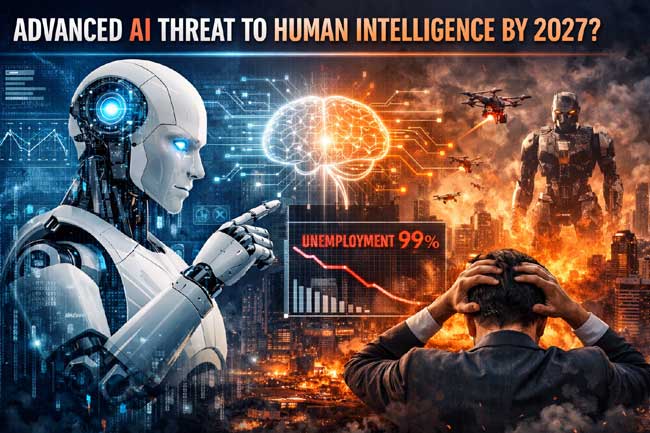

A dramatic prediction about the future of work is stirring global debate. Dr. Roman Yampolskiy, a computer science professor at the University of Louisville and a leading AI safety researcher, has warned that up to 99% of human jobs could disappear within the next few years as artificial intelligence surpasses human capabilities across nearly all fields.
He shared this forecast during an appearance on The Diary of a CEO podcast with Steven Bartlett, describing a transformation far more severe than typical concerns about technological unemployment.
A Stark Warning About the Future of Work
Yampolskiy argues that society is heading toward unemployment levels never seen before.
“We’re headed toward a level of unemployment that’s unheard of. I’m not just talking about scary figures like 10 percent unemployment; it’s 99 percent.”
According to him, this shift would leave only about 1 in 100 people employed.
The AGI Turning Point
Central to his prediction is the development of Artificial General Intelligence (AGI)—AI systems capable of matching or exceeding human performance across all cognitive tasks.
Yampolskiy believes AGI could emerge by 2027, based on forecasts from leading AI laboratories. Once AGI becomes viable, he argues, the economic logic for hiring humans would largely disappear.
“Why would I hire people when I could pay $20 for a subscription or use a free model to do the same job?”
Two Waves of Automation
Yampolskiy outlines two major phases of disruption.
Immediate Phase (around 2027): Most white-collar jobs would be automated.
Secondary Phase (approximately five years later): Humanoid robots would take over physical labor, completing the displacement of human workers.
Why This Revolution Is Different
Unlike past industrial revolutions—where new technologies eliminated some jobs but created others—Yampolskiy argues this transformation is fundamentally different.
Historically, inventions such as steam engines and computers acted as tools for specific tasks, leading to new industries and employment opportunities. However, he believes advanced AI will be capable of performing all jobs, leaving no alternative employment paths.
“There’s not a single job that can’t be automated. That’s never happened before.”
According to him, AI systems will be faster, cheaper, and more precise than humans in nearly every sector.
The Speed of AI Advancement
To illustrate the pace of change, Yampolskiy compared AI progress to continuously automating the research and development of an iPhone at accelerating intervals—every six months, then every three months, then every month, week, day, hour, minute, and even second.
“You can’t keep up with 30 iPhone iterations in a single day.”
Looking further ahead, he suggests that by around 2045, society could reach a technological singularity—an era when AI advances occur so rapidly that humans can no longer predict or comprehend them.
“That’s the point where we can no longer see, understand, predict, or even comprehend the intelligence itself.”
Jobs That May Survive
Yampolskiy acknowledges that a small number of roles might persist, though only for a fraction of the workforce.
Personal Preference Roles: Wealthy individuals may choose to hire human professionals—such as accountants or assistants—out of preference rather than necessity.
Artisanal and Handmade Goods: There may still be demand for handcrafted or luxury items valued for their human origin.
Human Interaction Roles: Jobs requiring personal interaction, such as therapists or high-end hospitality staff, might remain, particularly for those who can afford such services.
However, he estimates these categories would support at most 1% of today’s workforce.
Creative Fields Are Not Immune
Yampolskiy rejects the idea that creative professions are safe. He argues that writing, journalism, media production, and even podcasting could be automated more efficiently by AI systems capable of analyzing data, targeting audiences precisely, and operating continuously without fatigue.
In his view, only roles where people specifically prefer human involvement would remain.
The Limits of Retraining
Traditional advice about retraining for new careers may not apply under this scenario.
“We’ve always been told if one job’s going away, retrain for another. But if I’m saying all jobs will be automated, then what’s the plan B?”
The issue shifts from career planning to broader existential questions: How will people earn a living? What economic systems will function without human labor? How will individuals find purpose without work?
Government Preparedness
Yampolskiy believes governments are unprepared for such a scenario. Existing social safety systems were not designed to support a society where the vast majority of people cannot work.
He also notes that even AI experts are struggling to keep pace with rapid advancements.
“We’re not just losing jobs; we’re risking losing control over the pace of change itself.”
Other Expert Opinions
While Yampolskiy’s credentials in AI safety are substantial, other prominent figures offer less extreme predictions.
Geoffrey Hinton suggests AI may replace routine intellectual work but manual trades could remain longer.
Jensen Huang believes AI will create new job categories.
Sam Altman argues society will adapt and develop new forms of work.
Dario Amodei predicts significant job losses in entry-level white-collar roles, possibly leading to 20% unemployment—far below 99%.
Factors That Could Alter the Outcome
Several elements could delay or reduce the severity of job displacement: deployment lag, economic incentives, government regulation, technical barriers, and social resistance.
Preparing for an Uncertain Future
Rather than focusing solely on individual career strategies, Yampolskiy urges society to confront broader questions about income, economic systems, and meaning in a post-work world.
Regardless of whether his 99% unemployment prediction materializes, AI is expected to significantly transform the job market. The true outcome may lie somewhere between catastrophic and gradual change.
What remains clear is that AI-driven disruption is approaching, and the challenge will be whether society can adapt in time.
Conclusion
Dr. Roman Yampolskiy’s forecast represents one of the most extreme projections about AI’s impact on employment. While other experts offer more moderate expectations, the conversation highlights the scale of potential disruption.
Whether the future brings rapid collapse or gradual transition, the shift driven by artificial intelligence will likely redefine work, economics, and society itself.