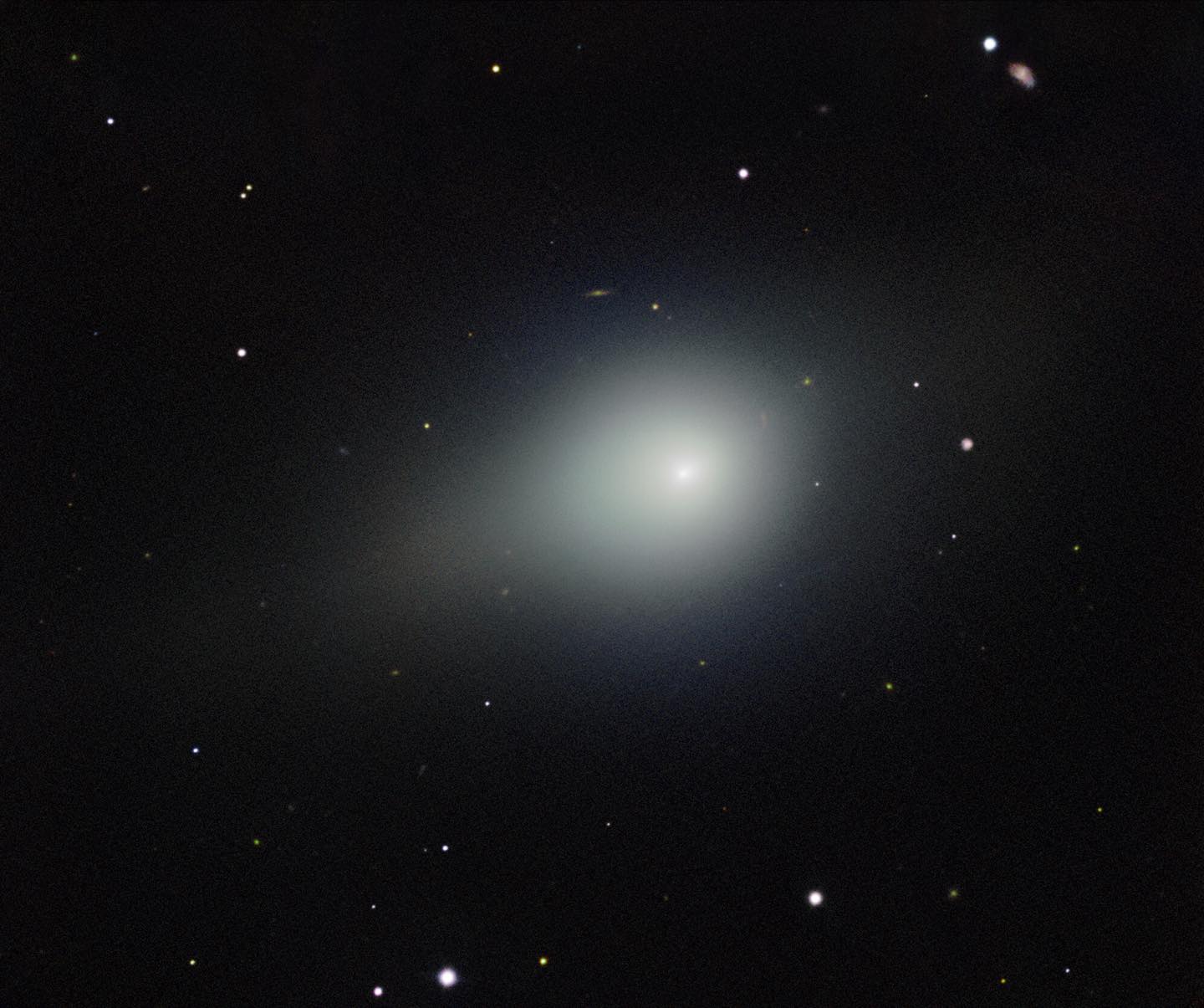

New Delhi, Dec 13 : On December 13, Comet 3I/ATLAS, only the third confirmed interstellar object to breach our solar system, captured global attention as it revealed a complex and rapidly evolving chemistry. This cosmic outsider, traveling on a hyperbolic trajectory, is being closely monitored by astronomers as it heads toward its closest, yet safely distant, approach to Earth on December 19, 2025. This passage is viewed as an unparalleled opportunity to conduct a real-time chemical biopsy of a star system beyond our own.
The comet was discovered by the ATLAS survey on July 1, 2025. Its non-native origin is confirmed by its hyperbolic path, meaning it is not gravitationally bound to the Sun. As a “foreign sample,” 3I/ATLAS is a valuable time capsule carrying materials from a distant planetary disk.
The Green Glow: A Change in Chemistry
Recent images from the Gemini North telescope show a distinctive greenish glow around 3I/ATLAS. This is the classic signature of diatomic carbon , a volatile molecule that fluoresces when energized by sunlight. The color shift, from a redder hue observed in earlier images, suggests that the comet’s perihelion (closest pass to the Sun on Oct. 29-30, 2025) has triggered the release of deeper, more heat-sensitive volatile materials. This provides quantifiable proof that the comet’s outgassing profile is rapidly changing due to solar heating.
First X-Ray Detection: Unlocking Invisible Gases
A major scientific breakthrough is the successful detection of X-rays, a first for an interstellar object.
ESA’s XMM-Newton captured X-rays on December 3, 2025, from a distance of approximately 282–285 million km. The X-rays are produced when the solar wind collides with the gases streaming off the nucleus.
JAXA’s XRISM reported a faint X-ray glow stretching approximately 400,000 km from the nucleus.
These X-ray observations are crucial because they can detect light elements, such as hydrogen and nitrogen , that are nearly invisible to standard optical and UV instruments. This allows scientists to compare the elemental ratios of 3I/ATLAS to solar system comets, offering a unique window into alien stellar nursery processes.
Final Trajectory and Compositional Clues
As 3I/ATLAS exits the solar system, the observation campaign continues:
Closest Approach: The comet will pass Earth on December 19, 2025, at a safe distance of approximately 270 million km (or 1.8 AU), posing no threat.
Multi-Point Tracking: Spacecraft around Mars, including MRO and MAVEN, have been critical in observing the comet when it was obscured by the Sun from Earth’s perspective.
Composition: Initial analysis, including data from JWST, has detected water ice, carbon dioxide, carbon monoxide, carbonyl sulphide, and a surprising signature of nickel.
Scientists are now focused on monitoring the comet’s decay rate to estimate the stability of its nucleus before it fades from view in the spring of 2026.