Pakyong, April 2 : Let’s be honest — if you have ever tried working on a deadline from somewhere in Meghalaya, Nagaland, or Sikkim, you already know the frustration. The call drops. The page refuses to load. The video buffers endlessly. And this is not a once-in-a-while problem. For millions of people living across India’s northeastern hills, unreliable internet is simply a way of life.
So when Meghalaya’s Chief Minister Conrad K. Sangma signed an MoU with Starlink India on April 1, 2026, right there in New Delhi alongside SpaceX’s own President and COO Gwynne Shotwell — it felt like more than a press-release moment. It felt like a turning point.
WHY THE NORTHEAST HAS ALWAYS BEEN DIFFERENT

India’s northeastern states are stunning. They are also, geographically speaking, genuinely difficult to connect. The terrain is what gets you — dense forests, steep mountain ridges, flood-prone valleys, and villages that sit hours away from the nearest town. Laying fibre optic cables or building mobile towers in places like these is not just expensive, it is often physically impractical.
The result? A region rich in culture, natural beauty, and human talent — but chronically left behind in the digital race. Schools run without stable broadband. Health workers can’t access telemedicine platforms. Farmers have no real-time market pricing. Young entrepreneurs with ideas find themselves boxed in by bandwidth.
This is not a new conversation. But until now, there was no genuinely scalable fix on the table.
ENTER STARLINK: INTERNET FROM 550 KM ABOVE YOUR HEAD
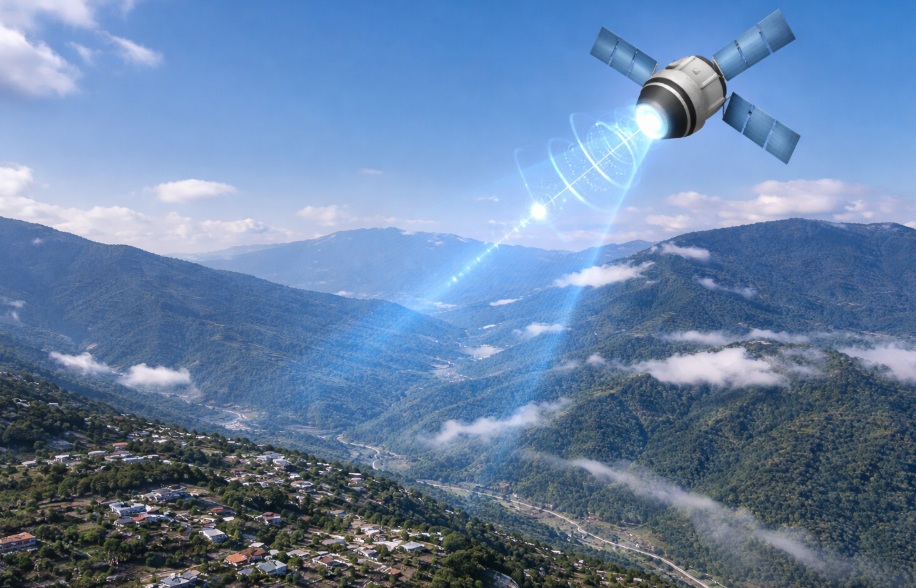
Here’s what makes Starlink different from anything that came before. Instead of relying on ground-based towers or undersea cables, it beams internet directly from a constellation of low Earth orbit satellites — sitting roughly 550 kilometres above the surface. You set up a small dish at your location. The sky does the rest.
No mountain is too remote. No valley is too isolated. If there’s a clear view of the sky, there’s internet.
For the Northeast, this is not a small upgrade — it is an entirely new paradigm. The Meghalaya government has been transparent about what they are hoping for. Classrooms in far-flung villages that can finally run digital learning tools. Health centres where a nurse can video-consult a specialist hundreds of kilometres away. Community hubs where farmers, artisans, and small business owners can tap into online markets without driving four hours to the nearest town with decent signal.
Chief Minister Sangma put it plainly — his administration has spent eight years cutting government process times from 30 days to 3 days. The infrastructure is increasingly there. What’s been missing is the last-mile connection that actually reaches people.
Starlink, at least in ambition, is designed to bridge exactly that gap.
BUT WHAT ABOUT SIKKIM?
Now here’s a question worth asking — if Meghalaya can do this, why not Sikkim?
Sikkim is in many ways the perfect candidate for a Starlink-style partnership. It is compact, mountainous, and one of India’s cleanest and most environmentally conscious states. It is also, arguably, India’s most premium tourism destination — attracting travellers who come for Kangchenjunga views, Buddhist monasteries, organic farms, and an experience that feels genuinely apart from the chaos of urban India.
And tourism, in the modern world, runs on connectivity.
Think about what reliable high-speed satellite internet could actually mean for Sikkim. Hotels and homestays in remote Lachung, Zuluk, or Dzongu could offer seamless connectivity to international guests who currently accept spotty signals as just part of the deal. Travel operators could run smoother bookings, real-time updates, and live communication with clients. Local artisans and Sikkimese entrepreneurs could sell directly to global markets without needing to relocate to bigger cities.
On the social side, the stakes are just as high. Sikkim’s remote communities — many of which are indigenous tribal groups — have long faced barriers in accessing quality education and healthcare. A child in a remote Lepcha village should not have to choose between staying home and losing access to good education, or leaving the hills entirely. Telemedicine alone could save lives in a state where the nearest specialist hospital is often a long mountain drive away.
Disaster resilience matters here too. Sikkim, as the 2023 glacial lake outburst flood reminded us so devastatingly, sits in one of the world’s most disaster-prone regions. When roads wash away and mobile towers go down, satellite internet stays up. That communication channel — whether for rescue coordination or public safety alerts — can be the difference between a bad day and a catastrophic one.
THE REGULATORY REALITY: NOT QUITE THERE YET
It would be irresponsible not to mention the elephant in the room. Starlink is not yet commercially operational in India. The company still needs satellite spectrum allocation from Indian regulatory authorities. There are security compliance requirements to be met, and local ground infrastructure — earth stations — needs to be established before services can go live.
These are not trivial hurdles. The path from signed MoU to a Sikkimese farmer streaming a market price update from Gnathang Valley is still some way off.
But the direction is set. Meghalaya is the latest in a series of state-level agreements — Maharashtra and Gujarat signed similar arrangements earlier. Starlink’s leadership, including Shotwell, is actively engaging with India’s central government. The regulatory timeline, while uncertain, appears to be moving.
A BROADER VISION FOR INDIA’S HILLS
What Meghalaya has started could — and should — inspire a template for the entire northeastern belt and beyond. The geography that has always been the region’s challenge is not going to change. But the technology to work around it is, for the first time, genuinely within reach.
If India is serious about digital equity — and about unlocking the economic and social potential of its most stunning, most culturally rich, and most underserved landscapes — then satellite internet is not a luxury. It is infrastructure. As essential as a road or a power line.
Sikkim, with its booming tourism sector, its clean-energy ambitions, and its deep commitment to sustainable development, could be a model state for exactly this kind of leap. The question is simply whether the will to push for it is there.
Given what is now possible, there has never been a better time to ask.