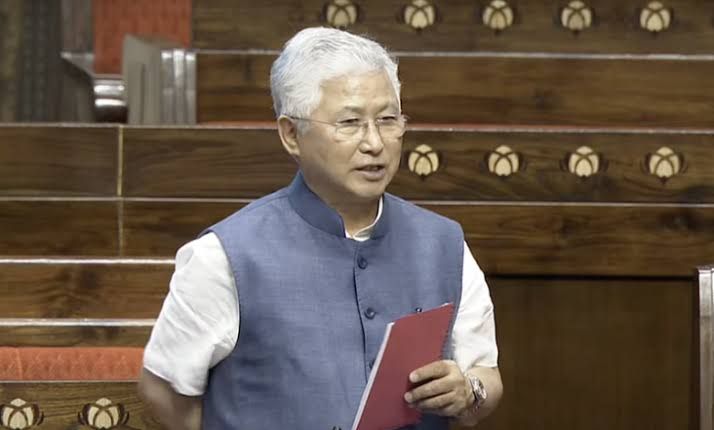

New Delhi, 6 Feb : Raising serious concerns over rural road connectivity in mountainous regions, Sikkim Rajya Sabha MP Shri D.T. Lepcha on Thursday urged the Central Government to reconsider certain Pradhan Mantri Gram Sadak Yojana (PMGSY) guidelines that, he said, are ill-suited for hilly states like Sikkim.
Speaking in Parliament, Lepcha acknowledged the vital role PMGSY has played in expanding all-weather road connectivity across rural Sikkim, significantly improving access to healthcare, education, markets, and livelihood opportunities. However, he pointed out that several remote villages still remain unconnected due to the rigid application of existing eligibility norms, particularly population-based criteria.
Highlighting Sikkim’s unique geographical challenges, Lepcha said the state’s fully mountainous terrain, sparse settlements, prolonged monsoon season, and high vulnerability to landslides demand a more flexible and region-specific approach. He emphasized that road connectivity in Sikkim is not only crucial for development but also holds strategic importance, as nearly 90 per cent of the state’s boundary lies along China, Bhutan, and Nepal.
The MP noted that the current population threshold of 250 persons for PMGSY eligibility excludes genuinely isolated habitations. He requested the Centre to lower the threshold to 150, ensuring equitable access to road infrastructure for all rural communities in the state.
Lepcha also raised concerns over the deteriorating condition of PMGSY roads, many of which have completed over seven years. Due to heavy rainfall and extreme weather conditions, these roads require urgent upgradation, strengthening, and resurfacing to maintain uninterrupted connectivity.
Criticising the existing 20 mm thin carpeting norm under PMGSY, he said it has proven inadequate in high-rainfall regions, leading to early wear and reduced lifespan of roads. He called for thicker and higher-specification surfacing, which would significantly enhance durability and reduce long-term maintenance costs.
Stressing the fragility of the Himalayan terrain, Lepcha further demanded mandatory protective and stabilisation measures in all PMGSY projects. These include retaining and bracing walls, proper drainage systems, and reverse-slope stabilisation structures capable of withstanding intensified rainfall.
Concluding his address, Shri D.T. Lepcha appealed to the Central Government to seriously examine these grievances and adopt policy modifications that reflect the realities of hill states like Sikkim.